

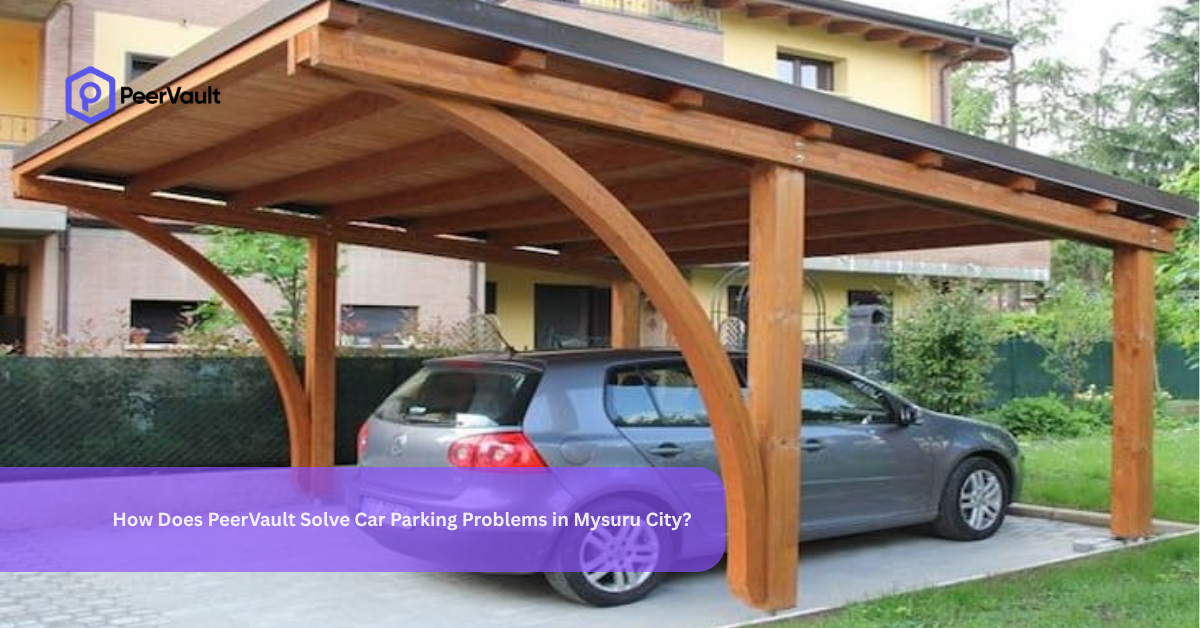
How Does PeerVault Solve Car Parking Problems in Mysuru City?
TL;DR :
Mysuru’s parking crunch is real congested commercial roads like D. Devaraj Urs Road and Sayyaji Rao Road, steadily rising vehicle registrations, non-compliant buildings skipping cellar parking, abandoned vehicles clogging residential lanes, and slow-moving multi-level parking projects. PeerVault addresses this not by building new infrastructure but by unlocking space that already exists: unused driveways, basements, and residential slots that owners list for others to book via app. Drivers search by location or landmark, compare verified spots, book and pay digitally, and get directions cutting down the time spent circling for parking near hotspots like Mysuru Palace, the railway station, and Devaraja Market. It’s not a replacement for civic planning or enforcement, but a faster, immediate way to add usable parking capacity while those bigger fixes catch up.
Mysuru has always been the kind of city people describe as calm, green, and well-planned. But if you’ve driven down D. Devaraj Urs Road on a Saturday afternoon, or circled Sayyaji Rao Road twice looking for a gap to squeeze your car into, you already know that reputation is under pressure. Mysuru’s parking problem isn’t hypothetical anymore; it’s a daily negotiation between drivers, shopkeepers, traffic police, and pedestrians who all want the same narrow stretch of road.
This is where PeerVault, a peer-to-peer parking and storage platform, has started to change the equation. Instead of adding more concrete to the city, it works with space that already exists unused driveways, empty basement slots, and residential parking bays that sit vacant for most of the day. Here’s a closer look at the problem, and how a platform like this actually fits into the solution.
The Real Scale of Mysuru’s Parking Problem
Mysuru’s roads were largely designed decades ago, long before the current volume of two-wheelers and cars became the norm.The same areas of congestion have identified by local reports on multiple occasions: D.Devaraj Urs Road, Sayyaji Rao Road, Dhanvanthri Road, Ashoka Road, Shivarampet, Santhepet, and the stretch near Jaganmohan Palace. These are commercial hubs where footfall is high and off-street parking was never built to match it.
The numbers tell the same story. Vehicle registrations in the city have climbed steadily thousands of new two-wheelers and four-wheelers are added every year, on top of the tourist vehicles that pour in throughout the year because Mysuru a major heritage destination. Business complexes are legally required to provide cellar parking for customers, but a large share of them simply don’t, which pushes the overflow straight onto the street. Multi-level parking projects at spots like Town Hall have proposed for years, with progress that residents describe as slow.
Add to that a growing number of abandoned vehicles sitting on roadsides in localities like Bannimantap, Agrahara, Nazarbad, and Gokulam, many without number plates, and you get a picture of a city where available road space is shrinking faster than the vehicle count is growing.
A Snapshot of the Problem
Issue | What's Happening in Mysuru |
Congested commercial roads | Chronic parking pressure on D. Devaraja Urs Road, Sayyaji Rao Road, Ashoka Road, and areas near Devaraja Market and Mysuru Palace |
Rising vehicle numbers | Continuous yearly growth in two-wheeler and four-wheeler registrations, plus seasonal tourist traffic |
Non-compliant buildings | Many businesses avoid the required subterranean parking, which pushes patrons out onto the street. |
Abandoned vehicles | Long-term roadside dumping in Bannimantap, Agrahara, Rajivnagar, Nazarbad, and Gokulam, reducing usable space |
Slow infrastructure projects | Multi-level parking initiatives at Town Hall and elsewhere have lagged behind demand |
Residential spillover | Homes with one car and one two-wheeler are increasingly common, and many layouts weren't built for that density |
None of this is unique to Mysuru most Indian cities are dealing with a version of the same story. But because Mysuru markets itself as a heritage and tourism city, the mismatch between old infrastructure and new traffic volume is more visible, and it hits both residents and visitors at the same time.
Why Traditional Fixes Fall Short
City authorities have tried the usual playbook: one-way roads, wheel-locking for vehicles parked over a set number of hours, stricter no-parking enforcement near palaces and markets, and proposals for multi-level parking structures. These help, but they’re slow to build, expensive to maintain, and they don’t address a simple fact: a lot of usable parking space in Mysuru already exists, it’s just privately owned and sitting empty.
Consider it from the perspective of a resident. A homeowner near Gokulam might have a driveway that’s empty from 9 AM to 6 PM every weekday while they’re at work. A shopkeeper on Sayyaji Rao Road might have an extra slot behind their store that nobody uses on weekends. None of that space shows up in any government parking count, but it’s exactly the kind of inventory a city like Mysuru needs.
How PeerVault Actually Works
PeerVault takes a peer-to-peer approach the same logic that ride-sharing and home-sharing platforms use, applied to parking. People who own unused parking space list it on the app or website. Drivers who need a spot search nearby, compare prices, check availability, and book directly.
Here’s what the process typically looks like for a driver in Mysuru :
1. Open the PeerVault app or website and either enable GPS or search a landmark like “Mysuru Palace” or “Mysuru Railway Station.”
2. Browse listed spaces nearby, filtered by distance, price, and availability.
3. Check details such as whether the spot gated, covered, or has CCTV.
4. Book and pay digitally through UPI, cards, or wallets.
5. Get directions to the exact spot and, if needed, message the host directly.
6. Receive a reminder before the booking period ends.
For someone who owns a spare spot, listing it takes a few minutes and turns dead space into a small, steady source of income.
What This Solves in Practice
Mysuru's Problem | How the P2P Model Responds |
Not enough visible parking near commercial areas | opens up previously inaccessible private locations close to marketplaces, palaces, and commercial areas. |
Tourist vehicles adding to congestion | Lets visitors pre-book a spot near attractions instead of circling for one |
Street parking causing footpath and traffic obstruction | Shifts vehicles off the road and into gated or private spaces |
Slow government infrastructure projects | Adds usable capacity immediately, without waiting for construction |
Idle residential and commercial space | Converts empty driveways and basements into active, monetized parking supply |
Lack of security in informal roadside parking | Offers verified listings, and in many cases CCTV or gated access |
Where This Matters Most in Mysuru
The areas under the most pressure around Mysuru Palace, Devaraja Market, the railway station, and the KSRTC bus stand are also the places where tourists and daily commuters overlap the most. A platform like this is particularly useful in exactly these zones, because it gives visitors a way to plan ahead instead of arriving and hoping for the best, and it gives residents in nearby layouts a way to earn from space they weren’t using anyway.
It also quietly helps with a problem the city hasn’t fully solved yet: vehicles idling or double-parked while drivers search for a spot. Every car that finds a pre-booked space instead of circling the block one less contributor to the congestion on roads that were already stretched thin.
Frequently Asked Questions
Q : What exactly is PeerVault?
It’s a peer-to-peer platform that connects people with unused parking space to drivers who need a place to park, using an app or website to browse, book, and pay for spots.
Q : How is this different from a regular paid parking lot?
Traditional lots are run by a single operator with fixed capacity. PeerVault instead aggregates many small, private spaces, driveways, basements, residential slots so the available inventory can grow without any new construction.
Q : Is it safe to park in a space booked through the app?
Listings are verified, and many spaces include gated access or CCTV. As with any shared-space platform, it’s still worth checking host ratings and reviews before booking, especially for longer durations.
Q : Can I book parking near Mysuru Palace or the railway station in advance?
Yes. You can search by landmark and reserve a spot ahead of time, which is particularly useful during peak tourist season when street parking around these areas fills up fast.
Q : Can I earn money by listing my own parking space?
Yes. If you have a driveway, basement slot, or extra space that sits empty for part of the day, you can list it and earn passive income when someone books it.
Q : Does this reduce traffic congestion in the city?
Indirectly, yes. Every driver who books a spot in advance instead of circling in search of one removes a small amount of unnecessary traffic from already congested roads like Sayyaji Rao Road and Ashoka Road.
Q : Is this a replacement for the city’s planned multi-level parking projects?
Not exactly it’s a faster-to-deploy complement. Government infrastructure projects take years; a P2P model adds usable capacity almost immediately by tapping into space that already exists.
The Bigger Picture
Mysuru doesn’t have a shortage of parking space so much as a shortage of organized access to it. There’s a version of this city where empty driveways in Gokulam, spare basement slots near Ashoka Road, and unused commercial lots near the palace are all working for the people who need them instead of sitting idle while cars circle the block outside. That’s the gap PeerVault built to close, one listed spot at a time.
It won’t replace the need for better civic planning, stricter enforcement against roadside dumping, or the multi-level parking projects the city has already promised. But while those larger fixes take shape, platforms like this offer something Mysuru’s drivers can actually use today: a way to find, book, and trust a parking spot without adding to the chaos on the street.
Contact Us to list your unused parking space and start earning with PeerVault.
Popular Posts
What Kind of Space Qualifies as a PeerVault Listing in India?