

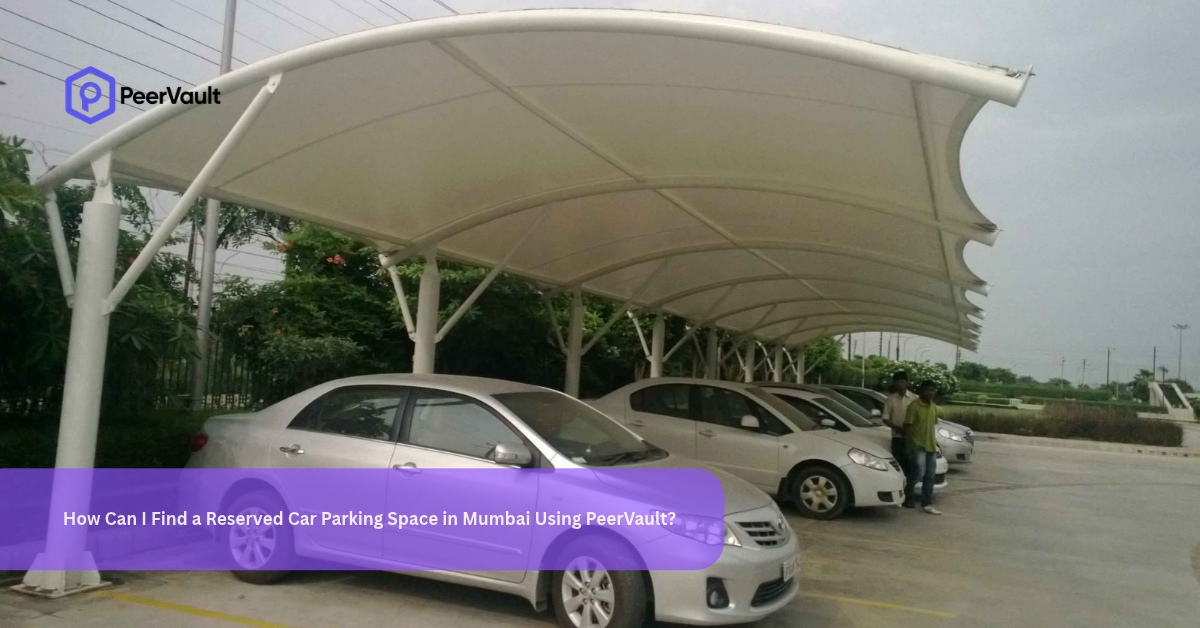
How Can I Find a Reserved Car Parking Space in Mumbai Using PeerVault?
TL;DR
- The problem : Mumbai has over 50 lakh registered vehicles, more than 700 new ones join the roads daily, and public parking can cover only a fraction of them. Civic fixes like underground lots will take years.
- The solution : A reserved parking space is a slot assigned only to you, so you don’t hunt for a spot each day.
- How to find one on PeerVault : Work out your area, hours and car size. Search the car parking listings for your locality, compare verified options, check the details, book and pay online, and do a test visit on day one.
- What to check first : Monsoon flooding, gate and ramp clearance, access hours, society permission, real security (monitored CCTV, night guard), notice period and EV charging.
- Cost : There’s no single Mumbai price. It depends on locality, covered or open, access hours and demand. Compare four or five live listings to find a fair rate.
- Why it’s worth it : Illegal parking can bring fines and towing, plus lost time, car damage and daily stress. A reserved spot often costs less than those add up to.
- Biggest mistakes to avoid : Booking without visiting, choosing on price alone, paying informally in cash, ignoring the fine print, and forgetting about the monsoon.
You can find a reserved car parking space in Mumbai by searching PeerVault’s car parking listings for your area, comparing verified spaces and prices, and booking online for a slot that stays yours every day. Check the location, access hours, security and monthly cost first, and read the terms before you pay.
The rest of this guide explains why reserved parking matters in Mumbai, how to find it, and what to check before you commit.
Why finding parking in Mumbai feels impossible
If you own a car in Mumbai, you already know the daily routine. You get home after a long day and drive around your own neighbourhood looking for a gap. You take the first one you find, even if it’s three lanes from your building.
The numbers back up the frustration. Mumbai has more than 50 lakh registered vehicles, over 700 new ones join the roads every day, and public parking infrastructure can barely cover a fraction of them. Density is part of it too. Government data shows Mumbai has the highest vehicle density among metro cities, at nearly 2,300 vehicles per kilometre, and more than 3 lakh vehicles were registered in the city in 2025 alone.
The supply side hasn’t kept up for years. A 2024 analysis by the Observer Research Foundation pointed out that the 2016 Comprehensive Mobility Plan estimated parking demand at 284,575 equivalent car spaces, but by 2022 the BMC’s available capacity was only 39,501, with another 26,815 managed by government and commercial bodies. Traffic expert Ashok Datar has said that roughly a third of the city’s vehicles end up parked on the roads.
The BMC is trying to fix this. In July 2026, it confirmed plans for 27 underground parking facilities across all wards. That’s welcome news, but large civic projects take years. If you need a dependable spot this month, you need a workable option now.
What “reserved parking” actually means
People use the word loosely, so it helps to be precise. A reserved parking space is one that is assigned to you, and only you, for an agreed period. You don’t compete for it, and nobody else parks there.
That’s different from :
- Street parking, which is free but unpredictable, and legal only where the signage allows it.
- Pay-and-park lots, where you pay per hour or day and a space isn’t guaranteed unless you have a pass.
- Open shared lots, where there’s a general area but no fixed slot.
With a reserved space, you know where you’ll park before you leave home. For anyone who drives to work daily, commutes from a station, or has a building with no parking left, that certainty is what you’re paying for.
How to find a reserved car parking space in Mumbai on PeerVault
PeerVault is a peer-to-peer platform. People and businesses with unused parking space list it, and people who need parking book it. In Mumbai, plenty of housing societies, offices, shops and independent homeowners have spare slots. PeerVault puts them in one place.
Here’s a practical way to use it.
1. Decide what you actually need
Before you search, write down three things :
- The area. Do you need parking near home, near your office, or near a station you commute from?
- The hours. Round-the-clock, night only, or weekday daytime?
- Your car’s size. A hatchback and a large SUV don’t fit the same slot. Mumbai’s older buildings and stilt parking are often tight.
Being specific keeps you from booking a spot that looks fine on paper and fails in practice.
2. Search the car parking listings for your locality
Open PeerVault, go to the car parking or car storage category, and search for your neighbourhood. Start with the exact locality, then widen to nearby areas if there isn’t a match. A spot ten minutes’ walk away in a quieter lane can cost less and be easier to get in and out of than one right next to a busy junction.
3. Compare listings, not just prices
Listings on the platform are verified, and you can compare options side by side. When you compare, look at more than the monthly rent :
- Is the space covered, open, or in a basement?
- Is there CCTV, a guard, or gated entry?
- What are the access hours?
- Is it one fixed slot, or a general area?
- What is the minimum booking period?
The cheapest option isn’t always the best one. A slightly higher rent for a gated, covered space is often worth it, especially during the monsoon.
4. Check the details before booking
Read the description carefully. If something is unclear, such as gate height, ramp gradient or whether the slot has a pillar next to it, ask the host before you pay. A good host will answer plainly.
5. Book and pay online
Once you’re happy, book through the platform. Online payment gives you a clear record of what you paid and for how long, which matters if there’s ever a disagreement. If something goes wrong with a listing, PeerVault’s customer support is your route for resolving it.
6. Do a test visit on day one
On your first day, drive in, park, and walk out. Make sure the slot fits your car, you can open the doors fully, and reversing out is realistic during the busy hours you’d actually use it. Fixing a problem in the first week is much easier than putting up with it for months.
How PeerVault compares with other ways to get parking in Mumbai
PeerVault isn’t the only route, and it’s worth being honest about the trade-offs.
Option | How reliable is the slot? | Typical strengths | Things to watch |
PeerVault listings | Reserved for you | Many localities, verified listings, online booking and payment, price comparison | Availability depends on what hosts have listed in your area |
Your own society or a neighbouring one | Reserved if agreed formally | Familiar, often walking distance | Needs society permission; informal arrangements can fall apart |
BMC pay-and-park lots | Depends on the lot | Regulated, open to all | Rates and rules vary; lots have historically offered monthly passes, with night rates lower than day rates |
Private commercial or mall parking | Often available via monthly pass | Security, staff | Can be pricier, and passes depend on the operator |
Street parking | None | Free | Fines, towing, and no guarantee of a spot |
For many people, a mix works best. You might use a reserved space near home and pay-and-park near the office.
What to check before you book any parking space in Mumbai
Mumbai has quirks that a generic parking checklist would miss.
Flooding during the monsoon. Basements and low-lying spots in certain areas can flood during heavy rain. Ask the host whether the space has ever waterlogged, and prefer a raised or covered slot if your car is important to you.
Gate and ramp clearance. Many older buildings have narrow gates and steep ramps. If you drive a tall or wide vehicle, confirm the measurements.
Access hours. A space that closes at 10 pm doesn’t help if you work late. Confirm you can get in and out when you need to.
Permission and paperwork. If the space is inside a housing society, the owner should have permission to rent it out. Ask whether the society is aware. Keep a copy of your booking or agreement.
Security in practice. CCTV and guards are a good sign, but ask whether the cameras are actually monitored and whether the guard is there at night.
Who else has access. Find out whether the slot is exclusively yours, and whether anyone else can block you in.
Notice period and refund terms. Know how much notice you need to give if you want to leave, and what happens if the host cancels.
EV charging. If you drive or plan to drive an electric car, ask whether charging is possible. Not every host allows it, and wiring inside societies can be a sticking point.
What does reserved parking cost in Mumbai?
There’s no single price, and any article that quotes one flat figure for the whole city isn’t being straight with you. Rates depend on :
- Locality. Prime business districts and south Mumbai cost more than the outer suburbs.
- Type of space. Covered and gated slots cost more than open ones.
- Access. Round-the-clock access is priced higher than night-only or weekday-only.
- Booking length. Longer commitments can be cheaper per month, though that depends on the host.
- Demand. Areas near stations, offices and hospitals see steady demand.
The best way to find a fair price is to compare four or five listings in your locality. You’ll quickly see what’s normal and what’s an outlier. Since rates change, check the live listings rather than relying on old figures from blogs or forums.
The real cost of not having a reserved spot
It’s easy to treat parking rent as an extra expense. Look at the alternative.
Illegal parking is enforced. Published fine figures vary by source, vehicle type and location, with some guides putting no-parking penalties anywhere from a few hundred rupees up to ₹10,000 once towing and other charges are added. One report noted that ₹2.74 crore was collected within a single week in December 2025 from e-challans issued to more than 23,000 vehicles for illegal parking. Rules and amounts change through municipal notices and police drives, so check the current figure on the Maharashtra e-challan portal or the Mumbai Traffic Police app instead of trusting an old number.
Add the less visible costs :
- Time. Twenty minutes of circling each evening adds up to well over a hundred hours a year.
- Damage risk. Cars parked tightly on roads pick up scratches, dents and broken mirrors.
- Stress. Coming home and not knowing whether you’ll find a spot affects your mood more than most people admit.
If you’ve been towed even once, a full year of reserved parking can start to look reasonable.
A note on the rules
A few points worth knowing :
- Parking on footpaths, in front of gates, in bus lanes or near junctions can get you fined or towed, even if others do it.
- Alternate-side parking rules apply on some roads, so check the signs.
- If someone blocks your access or parks illegally, you can complain through the BMC helpline 1916 or the Mumbai Traffic Police app, and you can call 112 for immediate obstructions.
- Property buyers now have more visibility too. MahaRERA has required developers to include detailed parking information in property documents. If you’re buying a flat, read those details carefully.
Common mistakes to avoid
1. Booking without visiting. Photos don’t show how tight the turn is. If you can, see the space first.
2. Ignoring the fine print. Check the notice period, the payment schedule and what happens if the host cancels.
3. Choosing only on price. A cheap spot with poor access or weak security costs more in the long run.
4. Paying informally in cash. Without a record, you have little recourse in a dispute. Book and pay through the platform.
5. Forgetting about the monsoon. Check drainage and flooding history before you sign up.
6. Leaving valuables in the car. Even in a secure space, it’s sensible not to.
If you have a spare parking spot
The other side of the platform is worth mentioning. If you own or manage a parking slot that sits empty, such as a spot you don’t use because you’ve sold a car or an office lot that’s empty at night, you can list it and earn from it. The same care applies as a host: describe the space accurately, set a fair price, and check whether your society allows outside renters.
Frequently asked questions
How do I find a reserved car parking space in Mumbai?
Search car parking listings for your locality on PeerVault, compare verified options, check security and access, then book online for a slot assigned to you.
Is it safe to rent a parking space from a stranger?
It can be, if you take sensible steps. Use listings that are verified, check security features like CCTV and gated entry, keep your booking record, and visit the space before committing.
What documents might I need?
Generally, an ID proof and your vehicle registration. Some hosts or societies may ask for an agreement, so confirm before you book.
Can I rent a parking space inside a housing society?
Often yes, but society usually needs to permit it. Ask the host whether they have approval.
Can I book for just one month?
Many people start with a short period to test the space. Minimum booking length depends on the listing, so check the details.
What if I have a problem with a host?
Contact PeerVault’s support team through the platform. This is one of the reasons to book and pay on the platform instead of informally.
Will my car be safe from flooding in the monsoon?
That depends on the space. Ask about waterlogging history and prefer covered or raised slots if flooding is a concern in your area.
Is reserved parking worth it compared to street parking?
If you drive daily, most people find it is, once you count fines, towing risk, time lost and damage. If you rarely use your car, occasional pay-and-park might be enough.
Final thoughts
Mumbai’s parking shortage isn’t going away soon. Civic projects like the planned underground facilities will help over time, but vehicle numbers are growing faster than the space to put them. In the meantime, having a fixed, reserved spot takes one daily source of stress off your plate.
Start by working out your area, hours and car size. Then compare a handful of listings on PeerVault, check security and access, do a test visit, and book online so everything is on record. Take your time with the checklist above, because a little care up front saves you from a bad arrangement later.
Also Read : What Are the Best Options for Paid Car Parking in Mumbai?
Still Searching for a Reserved Spot in Mumbai? Tell us your area, timings and car size, and our team will help you find a space that fits. Contact Us
Popular Posts
What Unused Spaces at Home Can I List on PeerVault to Earn Money?
How Do I Price My Space on PeerVault So Renters Actually Book It?