

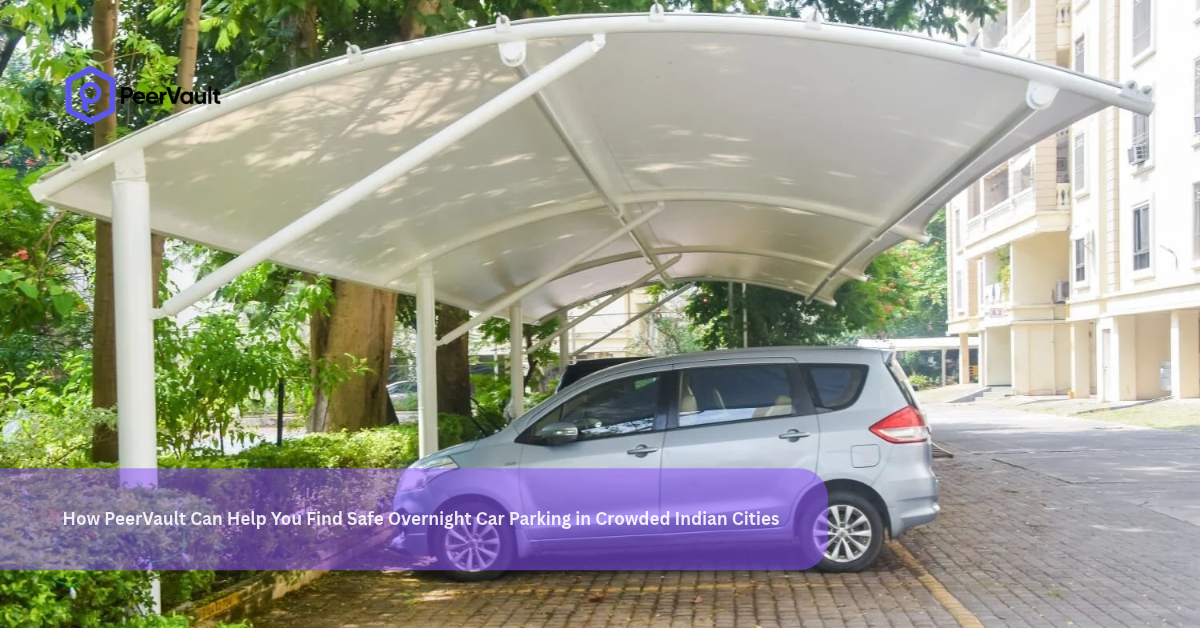
How PeerVault Can Help You Find Safe Overnight Car Parking in Crowded Indian Cities
TL;DR :
Indian cities are running out of safe parking faster than they’re running out of parking space, period vehicle numbers are set to nearly double by 2050, and cities like Mumbai already pack in ~2,300 vehicles per km. Overnight parking is riskiest of all: a vehicle is stolen every 2.3 minutes in India, and unattended cars on dark, unsupervised streets are the easiest targets. Existing fixes (free street parking, municipal lots, mall parking) either aren’t secure or aren’t available overnight. PeerVault addresses this by letting car owners book verified, gated, or watched private spaces spare society slots, driveways, private bays near their home or office on a monthly basis, often cheaper than informal “watchman” arrangements and far more accountable.
It’s 11 pm. You’ve just parked your car on the only open stretch of road near your apartment, wedged between a garbage bin and someone’s two-wheeler, and you’re already mentally rehearsing the walk down at 7 am to check if it’s still there. If this sounds familiar, you’re not imagining the problem you’re living a documented, worsening feature of Indian urban life.
Car ownership in Indian cities has grown faster than the infrastructure meant to hold those cars overnight. The result isn’t just inconvenience. It’s a genuine safety and financial risk that most car owners quietly accept because they don’t know there’s another option. This article walks through why overnight parking has become so difficult, what “safe” parking actually requires, and how a peer-to-peer platform like PeerVault fits into the solution with data, not assumptions, backing each claim.
The Scale of India’s Parking Problem
It helps to start with numbers, because the parking crunch in Indian cities isn’t anecdotal, it’s structural.
India’s urban population is projected to nearly double from 461 million in 2018 to 877 million by 2050, and this growth is expected to push the country’s vehicle population from 294 million to 494 million over the same period, with two-wheelers making up 70 percent of that stock. Even mid-sized, “early million-plus” cities, not just the usual metros are seeing parking demand outrun supply well ahead of schedule.
Mumbai illustrates what happens at the extreme end of that curve. The city now has the highest vehicle density among Indian metros, at nearly 2,300 vehicles per kilometre, up from around 1,840 in 2019 and roughly 1,150 in 2014, with more than 3 lakh new vehicles registered in 2025 alone. That density explains why housing societies, municipal bodies, and private operators are all scrambling for parking fixes at once.
Homebuyer data tells a similar story from a different angle. A recent study of residential listings found that Mumbai leads Indian cities in dedicated parking availability, with 75 percent of listed properties offering a parking space, followed by Pune, Delhi, and Navi Mumbai in the low-to-mid 70s percent range. Cities like Indore, Kanpur, Nagpur, Lucknow, and Chennai rank lowest, with parking availability in listed homes ranging from roughly 33 to 45 percent meaning a large share of car owners in these cities simply don’t have a guaranteed spot to begin with, dedicated or otherwise.
City | Homes with dedicated parking (approx.) | Parking pressure level |
Mumbai | 75% | Very high demand despite high supply |
Pune | 74.8% | High |
Delhi | 73.9% | High |
Navi Mumbai | 72.4% | High |
Chennai | 44.6% | Severe shortage |
Lucknow | 42.5% | Severe shortage |
Nagpur | 40.8% | Severe shortage |
Kanpur | 33.3% | Severe shortage |
Indore | 32.9% | Severe shortage |
Source: eXp India residential listings research, cited via Business Standard
The practical daily cost of this is measurable too. An IBM study found that the average Indian driver spends around 20 minutes every day just searching for a parking spot, translating into a real and recurring productivity loss. That’s before you even get to what happens once the car is actually parked for the night.
Why Overnight Parking Specifically Is the Riskiest Window
Daytime parking problems are mostly about availability. Overnight parking adds a second layer: exposure. A car left unattended for eight to ten hours on an unlit street, outside a locked society gate, or near a metro station is a very different risk profile from a car parked for two hours during a shopping trip.
The crime data backs this up. According to the National Crime Records Bureau, a vehicle is stolen somewhere in India roughly every 2.3 minutes, with more than 2.3 lakh vehicles reported stolen across the country in 2024 alone. Delhi recorded the highest number of vehicle thefts that year at 40,139 cases, followed by Bihar with 28,411, Maharashtra with 26,782, and Uttar Pradesh with 20,315.
Delhi’s trend has continued to worsen more recently. Car thefts in the national capital rose by over 52 percent in a single year, climbing from 1,662 cases to 2,529 cases over the same period compared to the year before. Investigators point directly at parking habits as the enabling factor: thieves often study the parking patterns of vehicle owners, exploiting situations where cars are left unattended for hours near metro pillars or ATMs, and SUVs are frequently targeted for their higher resale value.
It isn’t only theft of the whole vehicle. Component theft wheels, batteries, catalytic converters are common enough on Indian streets that owners in cities like Bengaluru and Mumbai have started using aftermarket locking nuts specifically because street-parked cars are seen as easy, low-supervision targets overnight.
Risk factor | Daytime parking | Overnight parking |
Duration unattended | 1–4 hours typically | 8–12 hours typically |
Lighting and visibility | Usually adequate | Often poor on residential streets |
Foot traffic / natural surveillance | Higher | Significantly lower |
Typical threats | Dents, towing, fines | Theft, vandalism, component theft |
Owner's ability to react quickly | High | Low (asleep, no visibility) |
What “Safe” Actually Means for Overnight Parking
Before comparing options, it’s worth being specific about what safety criteria actually matter, because “safe parking” gets used loosely in most marketing copy. Based on how insurers, urban mobility researchers, and law enforcement describe risk factors, a genuinely safer overnight spot should offer:
- Enclosed or gated access, not an open public road
- Some form of surveillance or a caretaker/watchman presence, even informal
- Consistent lighting through the night
- Restricted entry so the space isn’t a through-route for strangers
- A known, identifiable host or operator you can contact if something looks wrong
- Enough clearance and surface quality to avoid scrapes, waterlogging, or getting boxed in
Most free street parking fails on at least three or four of these points simultaneously, which is exactly why theft and damage cluster around it.
Where Existing Options Fall Short
Indian cities have tried several fixes, with mixed results :
- Free street parking remains the default for most car owners but offers effectively none of the safety criteria above. The core issue is the rapid growth in car ownership combined with the widespread practice of free parking on public land, which has led to disputes over open-space parking in cities like Noida and Vadodara, and even a Supreme Court judgment noting that free parking violates the fundamental right to walk on footpaths.
- Municipal paid parking is expanding but is patchy in coverage and rarely designed for overnight, multi-hour stays near residential areas.
- Mall and commercial lot parking is safer but usually restricted to operating hours and not built for overnight use.
- Policy responses are emerging states and cities have started introducing rules like Maharashtra’s “No Parking, No Car” policy in 2025 and Bengaluru’s Parking Policy 2.0 in 2021 to regulate the space but enforcement and rollout take years, and they don’t solve tonight’s parking problem.
This is the gap that peer-to-peer parking marketplaces are built to fill: matching people who have a genuinely secure, unused space (a spare slot in a gated society, a private driveway, an underused commercial bay) with people who need somewhere reliable to park overnight, often just a few streets away.
How PeerVault Fits Into This
PeerVault works on a straightforward premise: many residential buildings, gated communities, and private property owners across Indian cities have parking capacity that sits empty overnight, a second slot nobody uses, a driveway free after working hours, a basement bay in a building with fewer cars than allotted spaces. PeerVault lists these as bookable spaces, city by city, so a car owner searching for overnight parking isn’t limited to the street outside their own building.
Here’s how the process typically plays out for someone looking specifically for a safer overnight option :
1. Search by locality, not just city. Because overnight parking only works if it’s close enough to be practical, PeerVault’s listings are organised down to the neighbourhood level so someone in Koramangala, Bengaluru, or Andheri, Mumbai, can filter for spaces within walking distance rather than browsing city-wide results.
2. Check the listing details before booking. Good listings specify whether the space is gated, covered, has a watchman, and what the access hours look like the same criteria outlined earlier in this article.
3. Message the host directly. Because hosts are verified individuals rather than anonymous lot operators, renters can ask specific questions: is there CCTV, is the gate manned at night, is there space for an SUV before committing.
4. Book and pay monthly rather than nightly. For people who need this every night (not a one-off), monthly plans work out considerably cheaper than either informal “parking fees” paid to local attendants or the fines that come with getting towed from restricted zones.
5. Use in-platform communication for any issues, rather than relying on informal, undocumented arrangements that are hard to enforce if something goes wrong.
The underlying value isn’t that PeerVault invents new parking capacity out of nowhere, it’s that it makes visible, bookable, and accountable a supply of secure private space that already exists but was previously invisible to anyone outside the building or society that owns it.
Comparing Overnight Parking Options
Option | Typical cost | Security level | Availability | Best suited for |
Free street parking | ₹0 | Low | High (where legal) | Short-term, low-risk areas only |
Municipal paid lot | ₹20–₹100/night | Medium | Limited overnight hours | Occasional visitors |
Mall/commercial parking | ₹50–₹150/night | Medium-high | Usually closes overnight | Daytime use, not overnight |
Informal "parking dada" arrangement | ₹500–₹1,500/month | Low, unverifiable | Inconsistent | Those with no other option |
PeerVault (P2P booking) | Varies by city and listing, often ₹1,500–₹6,000/month | Depends on listing, filterable for gated/covered/watched | City-dependent, growing | Regular overnight parking near home or office |
Pricing on PeerVault reflects real market listings shown on the platform for instance, a covered car parking spot in Bengaluru has been listed at around ₹2,400 per month, while listings in Noida and Chennai have ranged from roughly ₹2,000 to ₹3,500 per month, depending on size, covering, and location. These are materially lower than what many car owners already pay informally to local watchmen for “protection” with none of the accountability.
A Practical Checklist Before Booking Any Overnight Spot
Whether you use PeerVault or any other route, run through this before committing to a spot for regular overnight use :
- Visit the space in person at least once before the first paid booking, ideally after dark
- Confirm whether the gate or entrance is locked, manned, or open access
- Ask how many other vehicles use the same space and whether it gets congested
- Clarify what happens if you need to leave unusually early or return unusually late
- Get the host’s direct contact number, not just an in-app message thread
- Check your car insurance policy to see whether parking location affects your theft coverage or claims
Frequently Asked Questions
Is peer-to-peer parking legal in India?
Renting out a privately owned or allotted parking space is generally permissible, though housing societies may have their own bylaws about subletting allotted slots to non-residents. It’s worth checking your society’s rules, or looking for listings from independent property owners where this isn’t a factor.
How is this different from just asking a neighbour informally?
The main difference is accountability and consistency. Informal arrangements rarely come with any documentation, fixed terms, or recourse if the arrangement falls through with no notice. A platform-based booking gives both sides a clearer, more dependable agreement.
Does renting a private spot actually reduce theft risk compared to the street?
It reduces exposure to the specific conditions: poor lighting, no supervision, high through-traffic that the NCRB and insurer data above associate with higher theft rates. It isn’t a guarantee, but it removes several of the biggest risk factors at once.
The Bottom Line
Overnight parking in Indian cities isn’t going to get easier on its own. Vehicle ownership is rising faster than city infrastructure can keep pace with, and policy fixes will take years to show up on your street. In the meantime, the most practical lever available to individual car owners is finding underused, genuinely secure private space nearby and turning it into a reliable arrangement. That’s the specific problem PeerVault is built around solving, one neighbourhood listing at a time.
Contact Us to List Your Space or Book a Safe Parking Spot Near You
Popular Posts
How Do I Price My Space on PeerVault So Renters Actually Book It?
What Kind of Space Qualifies as a PeerVault Listing in India?