

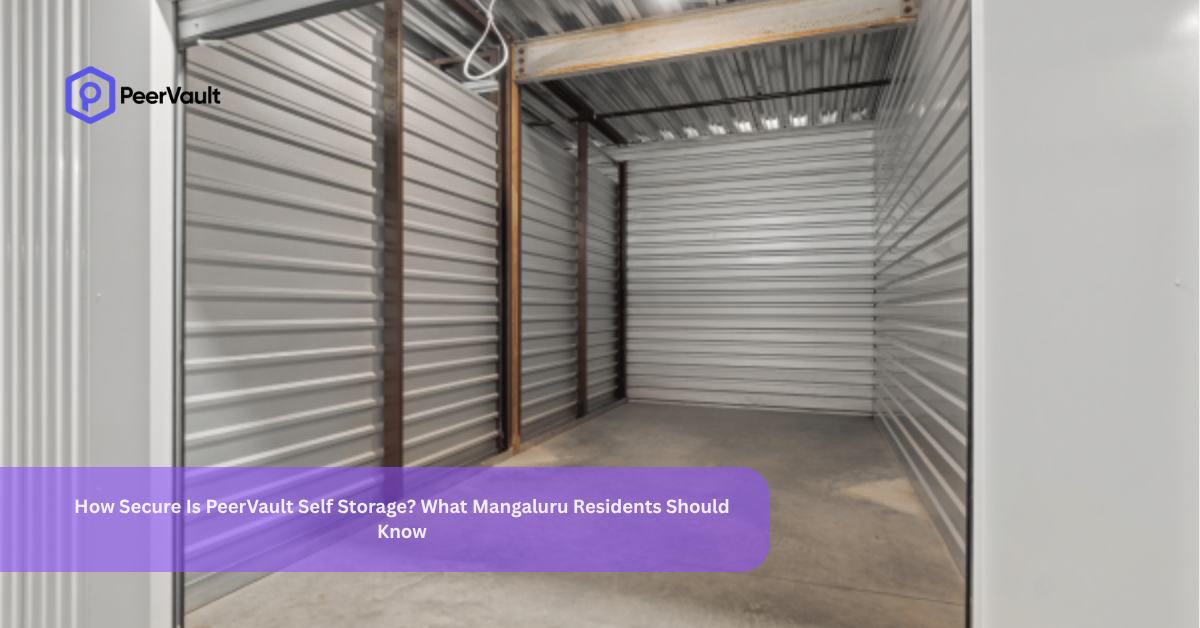
How Secure Is PeerVault Self Storage? What Mangaluru Residents Should Know
TL;DR :
PeerVault Self Storage in Mangaluru relies on layered security CCTV monitoring, individually locked units, controlled facility access, and staff oversight rather than any single feature. Before booking with any storage provider, verify camera coverage, who else can access your unit, the locking system, insurance terms, and monsoon/flood preparedness (a Mangaluru-specific concern). Keep irreplaceable items like original documents and jewelry in a bank locker instead. A transparent provider that answers these questions directly, in writing, is the strongest security signal you can look for.
PeerVault Self Storage in Mangaluru is built around layered security CCTV monitoring, individually locked units, restricted facility access, and staff oversight designed to protect belongings ranging from household furniture to business inventory and important documents. But “secure” means different things depending on what you’re storing, so this guide breaks down exactly what to look for, what questions to ask, and how self storage security in Mangaluru compares to your other options.
If you’re a homeowner between moves, a business owner needing overflow inventory space, or a student heading home for the semester, security is usually the first (and most valid) worry before you hand over your belongings to a third party. This article walks through the real mechanics of storage security, the standards worth expecting, and how to evaluate any facility PeerVault included before you commit.
What Does “Secure Self Storage” Actually Mean?
A genuinely secure storage facility combines physical barriers, surveillance, access control, and accountability not just a lock on a door.
Security is a system rather than a single feature. A facility can have a shiny padlock and still be poorly secured if there’s no camera coverage, no visitor logs, or no perimeter fencing. When evaluating any self storage provider in Mangaluru, look for these four layers working together :
1. Physical security fencing, gated entry, individually locked units
2. Surveillance CCTV coverage across corridors, entry points, and storage floors
3. Access control ID verification, access logs, or keypad/biometric entry
4. Human oversight on-site or on-call staff who monitor activity and respond to issues
A facility missing even one of these layers has a real gap, regardless of how modern it looks on the outside.
What Security Features Does PeerVault Self Storage Offer in Mangaluru?
PeerVault combines CCTV surveillance, individually locked storage units, and controlled facility access to reduce the risk of theft, tampering, or unauthorized entry.
While exact specifications can vary by branch and unit type, here’s what customers should expect and confirm before booking :
- CCTV coverage across common areas, corridors, and entry/exit points, typically retained for a defined review period
- Individual locking mechanisms on each unit, so no customer can access another’s space
- Controlled entry, limiting facility access to verified customers and authorized staff
- On-site or on-call staff during operational hours to handle emergencies or suspicious activity
- Fire safety provisions, such as extinguishers or smoke detection, which matter as much as theft prevention
Before booking any unit, ask the facility directly for their current security specification sheet and reputable providers will share this without hesitation.
Is It Safer to Store Things on Your Own Than at Home?
For many households, yes especially for high-value or rarely accessed items, since a dedicated storage facility typically has more consistent monitoring than an empty or infrequently visited home.
Consider this comparison :
Factor | Home Storage (Empty Room/Garage) | PeerVault-Style Self Storage |
Surveillance | Rare, often none | CCTV-monitored common areas |
Access control | Whoever has a house key | Verified, logged entry |
Fire risk management | Depends on homeowner | Facility-level fire safety systems |
Pest/humidity control | Often unmanaged | Climate-conscious storage available |
Staff oversight | None | On-site/on-call personnel |
Cost | "Free" but ties up space | Predictable monthly fee |
That said, self storage isn’t automatically safer for everything. Original documents like property deeds or passports are usually better kept in a bank locker or fireproof home safe rather than general storage, regardless of the facility’s security.
What Should You Personally Check Before Trusting Any Storage Facility?
Don’t rely on marketing claims alone, verify security in person or ask pointed questions before signing an agreement.
Here’s a practical checklist :
- Ask to see the CCTV setup where cameras are placed, and for how long is footage stored?
- Check who else has access, can staff enter your unit without you present, and under what circumstances?
- Verify whether the locking system is a facility-managed lock or a normal padlock that you supply.
- Ask about insurance. Does the facility offer contents insurance, or do they expect you to arrange your own?
- Review the liability clause in the storage agreement this tells you what happens if something goes wrong
- Visit during off-peak hours if possible, to see how the facility operates when it’s quiet
A facility that answers these questions transparently, without vague reassurances, is generally a good sign of operational maturity.
Does PeerVault Offer Insurance or Liability Coverage?
Storage facilities typically offer either bundled or optional contents insurance, and customers should always confirm coverage details in writing rather than assuming it’s included.
This is one of the most commonly misunderstood parts of self storage. Even with strong physical security, no facility can guarantee zero risk fires, floods, and rare theft incidents can still occur.
Because of this, insurance whether it is offered by the facility or obtained separately through a general insurer is an essential addition to physical security rather than its substitute.
When comparing storage providers in Mangaluru, ask specifically :
- Does the cost of the rental include insurance, or is it an additional cost?
- What’s the maximum claimable value per unit?
- Are high-value items (electronics, jewelry, documents) excluded from standard coverage?
How Does Self Storage Security Compare to a Bank Locker or Godown Rental?
Bank lockers offer the highest security for small valuables but very limited space; godowns (warehouses) offer scale but often weaker individual-unit security; self storage sits in between, balancing space, accessibility, and monitored security.
- Bank lockers : Best for documents, jewelry, small valuables. Extremely secure but not practical for furniture or bulk inventory.
- Godown/warehouse rental : Suited for large-scale business inventory, but security often depends heavily on the specific landlord’s setup inconsistent across providers.
- Self storage (PeerVault-style) : Designed for household and business use in between these extremes, individually locked units, monitored common areas, and flexible sizing.
The right choice depends on what you’re storing and for how long, not just which option sounds most secure on paper.
What Are Mangaluru Residents Commonly Worried About With Self Storage?
Based on common questions in the self storage space, here are the recurring concerns worth addressing directly :
“What if there’s a break-in?”
Reputable facilities carry insurance precisely for this low-probability scenario, and CCTV footage assists in resolution and claims.
“Can staff access my unit without permission?”
In well-run facilities, staff generally cannot access individually locked units except in emergencies (e.g., suspected fire or hazard), and this should be clearly stated in your agreement.
“What happens during floods or monsoon season?”
Coastal cities like Mangaluru see heavy monsoon rainfall, so ask specifically about flood-proofing, elevated flooring, or drainage systems; this is a regionally relevant question that generic storage guides often miss.
“Is my data or personal information safe when I register?”
Ask how your KYC documents and personal details are stored and whether they’re shared with third parties.
Frequently Asked Questions
Is self storage safe for storing important documents?
Original legal documents are generally safer in a bank locker or fireproof safe. Storage units are better suited for bulky belongings, furniture, seasonal items, and business inventory rather than irreplaceable paperwork.
Do self storage units have 24/7 CCTV monitoring?
Most established facilities monitor common areas continuously, but coverage inside individual locked units isn’t standard (for customer privacy). Always confirm the exact scope of monitoring.
What happens if my belongings are damaged in storage?
This depends entirely on your agreement’s liability clause and whether you’ve opted into insurance coverage. Always read this section before signing.
Can I access my storage unit at any time?
Access hours vary by facility. Some offer extended or 24/7 access; others operate within fixed business hours. Confirm this before booking if flexible access matters to you.
The Bottom Line
Security in self storage isn’t about a single lock or camera, it’s a combination of physical barriers, surveillance, access control, staff accountability, and insurance backing. PeerVault’s approach in Mangaluru reflects the standard layered-security model that reputable facilities follow, but as with any storage decision, the responsibility to verify specifics insurance terms, access policies, flood preparedness sits with the customer too.
Before booking any unit, don’t just take a website’s word for it. Ask the questions above, request documentation, and if possible, visit the facility in person. A transparent provider will welcome the scrutiny and that transparency is itself one of the strongest security signals you can look for.
Contact Us to learn how PeerVault keeps your belongings safe and protected.
Popular Posts
What Kind of Space Qualifies as a PeerVault Listing in India?