

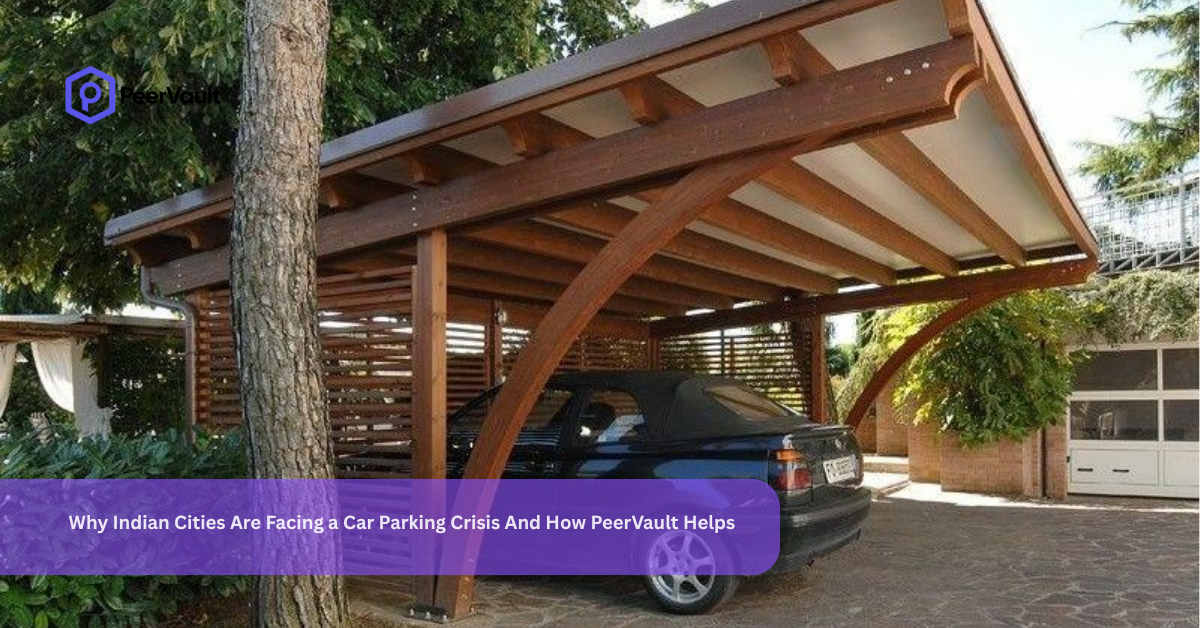
Why Indian Cities Are Facing a Car Parking Crisis And How PeerVault Helps
TL;DR :
Indian cities have far more vehicles than legal parking spots, and old buildings, expensive urban land, under-parked commercial areas, and weak public transport mean the gap keeps widening, costing drivers time, money, and stress while forcing unsafe illegal parking. PeerVault fixes this without waiting for new construction : it turns thousands of idle garages, driveways, and unused parking slots across Indian cities into a searchable rental marketplace, letting renters book affordable monthly spots nearby and letting space owners earn passive income from parking they weren’t using anyway.
If you’ve ever circled a block in Mumbai for twenty minutes looking for a legal place to park, paid a “convenience fee” to a random attendant in Bengaluru, or watched a parking dispute turn into a full-blown society WhatsApp group war in Delhi NCR you already know India has a parking problem. It isn’t a minor inconvenience anymore. It’s a full-blown urban infrastructure crisis, and it’s only getting worse as vehicle ownership outpaces road and parking capacity in almost every major Indian city.
In this article, we’ll break down why the parking crisis exists, what it’s actually costing Indian city-dwellers (in money, time, and stress), and how a peer-to-peer model like PeerVault is quietly fixing a problem that city planning hasn’t been able to solve for decades.
The Scale of India’s Parking Problem
India’s vehicle population has grown at a pace that city infrastructure was never designed for. Two- and four-wheeler ownership has multiplied several times over in the last two decades, while the amount of dedicated parking space in most Indian cities has barely moved. The result is predictable: more cars chasing the same limited number of parking spots, year after year.
A few numbers tell the story :
- Most Indian metros have parking demand that is estimated to be several times higher than the legally sanctioned parking supply.
- A large share of on-street “parking” in Indian cities is technically illegal or unauthorized — cars parked on footpaths, in no-parking zones, or blocking traffic lanes simply because there’s nowhere else to go.
- Studies on urban congestion consistently point to “cruising for parking” the time drivers spend circling in search of a spot as a meaningful contributor to traffic congestion and fuel wastage in dense city centers.
This isn’t just a Mumbai or Bengaluru problem. It shows up in Delhi, Pune, Hyderabad, Chennai, Ahmedabad, Gurugram, Noida, and increasingly in Tier-2 cities where car ownership is rising faster than infrastructure can keep up.
Why the Crisis Keeps Getting Worse
1. Old Buildings Weren’t Designed for Today’s Car Ownership
A huge number of residential buildings and housing societies in Indian cities were built at a time when one parking spot per flat (or even one spot per building) was considered generous. Today, many households own two or three vehicles. The math simply doesn’t work. Societies end up allotting parking on a first-come-first-served or seniority basis, leaving newer residents, tenants, and second-car owners with nowhere legal to park.
2. Commercial Areas Are Chronically Under-Parked
IT parks, business districts, and commercial hubs in cities like Bengaluru, Gurugram, and Hyderabad were often approved with parking ratios that made sense on paper but never accounted for real-world employee vehicle ownership. The result: employees either pay steep private parking rates, park illegally on access roads, or waste 20–30 minutes every morning hunting for a spot.
3. Urban Land Is Too Expensive to “Waste” on Parking
Land in Indian metros is some of the most expensive in the world relative to income. Developers and municipal planners are naturally reluctant to allocate large amounts of prime real estate purely for parking, especially in already dense areas. This keeps formal parking supply structurally lower than demand, indefinitely.
4. Public Transport Hasn’t Reduced Car Dependency Enough
While metro and bus networks have expanded in cities like Delhi, Bengaluru, and Chennai, most Indian cities still don’t have the kind of last-mile connectivity that makes people comfortable giving up their vehicles. Car and two-wheeler ownership keeps climbing even as roads and parking stay flat.
5. Enforcement Is Inconsistent
Illegal parking is technically punishable, but enforcement varies wildly by city, ward, and even by the day of the week. This inconsistency means drivers often gamble on illegal parking rather than pay for safe, legal alternatives not because they want to break rules, but because legal parking is often simply unavailable nearby.
What the Parking Crisis Actually Costs You
The parking crisis isn’t just an abstract planning failure it has real, measurable costs for ordinary people :
- Time lost. Circling for parking in a dense commercial area can easily eat up 15–30 minutes a day; that’s over 100 hours a year for a regular commuter.
- Money lost. Parking fines, “unofficial” attendant fees, and premium private parking rates near offices and hospitals add up fast, often far more than a fair monthly rental would cost.
- Stress and conflict. Parking disputes are one of the most common sources of tension in Indian housing societies and gated communities; arguments over “reserved” spots, blocked driveways, and unauthorized parking are a near-universal complaint.
- Vehicle damage risk. Cars parked on streets or in unsecured spots face a higher risk of dents, theft, and weather damage compared to a secure, dedicated parking spot.
- Opportunity cost for space owners. On the flip side, thousands of homeowners, shopkeepers, and property owners across Indian cities have unused garages, extra driveway space, or vacant plots sitting in completely idle space that could be generating steady monthly income.
That last point is exactly where the opportunity lies and it’s the gap PeerVault was built to close.
Enter the Peer-to-Peer Parking Model
Traditional solutions to the parking crisis: building more multi-level car parks, enforcing stricter parking codes, expanding public transport are all necessary, but they’re slow, expensive, and controlled by municipal bodies and large developers. They take years, sometimes decades, to materially change the picture.
Peer-to-peer (P2P) parking takes a completely different approach: instead of waiting for the city to build more parking, it unlocks parking space that already exists but sits unused.
Think about how much idle parking capacity exists in any Indian city at any given time :
- A homeowner in a residential society who owns a car and a two-wheeler but has an extra allotted parking slot they don’t use.
- A shop or office that’s closed on weekends but has parking that goes empty every Saturday and Sunday.
- A house with a driveway or extra open plot near a busy commercial or transit area.
- A gated community with surplus visitor parking that’s rarely used to capacity.
None of this space shows up in official parking statistics but it’s real, it’s available, and it’s sitting there generating zero value for its owner while someone two streets away is circling for a spot.
How PeerVault Solves the Parking Problem
PeerVault is a peer-to-peer self-storage and parking platform that connects people who need space including car parking with hosts who have space to spare. It works on a simple idea: turn unused private space into a searchable, bookable marketplace.
For Renters (People Who Need Parking)
- Search by city and location. PeerVault lists car parking spaces across cities including Mumbai, Delhi, Bengaluru, Pune, Chennai, Hyderabad, Noida, Gurugram, and more — so you can find a spot close to home, work, or a specific commercial area.
- Flexible monthly plans. Instead of daily hunting or paying inflated informal rates, renters can lock in a fair, transparent monthly price.
- Verified hosts and secure communication. PeerVault verifies users and provides in-platform messaging, so renters can ask questions and confirm details before committing.
- No long-term lock-in. Renters aren’t tied into rigid municipal contracts; they can choose plans that suit their actual needs.
For Hosts (People With Unused Parking Space)
- Turn idle space into income. A parking spot that’s sitting empty is a missed opportunity. Listing it on PeerVault turns it into a steady monthly earning.
- List in minutes. Hosts can add their space, set pricing, and start receiving inquiries without dealing with brokers or informal middlemen.
- Stay in control. Hosts choose who they rent to, communicate directly, and manage bookings through the platform.
- Insurance and safety options. PeerVault’s insurance protection features add a layer of security that informal, word-of-mouth parking arrangements simply don’t offer.
Why This Model Matters for India’s Cities
Peer-to-peer parking doesn’t just solve an individual’s problem it chips away at the structural causes of the parking crisis :
1. It increases effective parking supply without new construction. Every listed spot is capacity that didn’t exist in the searchable market yesterday.
2. It reduces illegal and unsafe parking. When legal, affordable options are easy to find, fewer people are forced onto footpaths, no-parking zones, or unsafe streets.
3. It cuts down on “cruising for parking” congestion. Knowing exactly where a spot is available and having it reserved in advance removes the need to circle blocks searching.
4. It creates a fairer market. Instead of informal cash payments to unofficial attendants, money goes directly to the person who owns the space, and pricing is transparent.
5. It scales with the city. As more hosts list spare space, supply grows organically in exactly the neighborhoods where demand is highest, something municipal planning struggles to do quickly.
Real Scenarios Where PeerVault Makes a Difference
- The IT professional in Bengaluru who spends 25 minutes every morning looking for parking near their office can instead book a monthly spot two minutes from their building.
- The homeowner in Chennai with an empty garage they haven’t used since selling their second car can list it and earn passive monthly income instead of letting it sit idle.
- The small business owner in Pune whose shop has after-hours parking capacity can rent it out to nearby residents in the evenings and weekends.
- The tenant in Noida who moved into an apartment without an allotted parking slot no longer has to fight over society parking; they can book a nearby spot in minutes.
The Bottom Line
India’s car parking crisis isn’t going away on its own. Vehicle ownership will keep rising, urban land will keep getting more expensive, and municipal infrastructure will keep struggling to catch up. Waiting for cities to “solve” parking through new construction alone isn’t realistic in the short or even medium term.
What can change quickly is how efficiently we use the space that already exists. Peer-to-peer platforms like PeerVault turn thousands of idle garages, driveways, and unused parking slots across Indian cities into a searchable, bookable, income-generating network solving the parking crisis one spot at a time, without waiting for a single new multi-level car park to be built.
Whether you’re a driver tired of circling the block or a space owner sitting on an empty parking slot every month, the fix might already be closer than you think.
Looking for a parking spot near you? Search car parking listings on PeerVault across your city.
Have unused parking space? List your space on PeerVault and start earning today.
Frequently Asked Questions
Why is it so difficult to find parking in Indian cities?
Most Indian cities have far more vehicles than sanctioned parking spaces, largely because older buildings, commercial areas, and municipal planning weren’t designed for today’s level of car and two-wheeler ownership.
How does peer-to-peer parking work?
Platforms like PeerVault let people with unused parking space, homeowners, shopkeepers, and property owners list that space for others to rent, usually on a flexible monthly basis, instead of it sitting idle.
Is renting a private parking spot cheaper than informal or municipal parking?
It’s often more transparent and predictable. Instead of paying variable “convenience fees” or risking fines for illegal parking, renters pay a fixed monthly rate agreed upfront with the host.
Can I earn money by renting out my unused parking space?
Yes. If you have a parking slot, garage, or driveway that isn’t in regular use, you can list it on PeerVault and earn steady monthly income from renters in your area.
Which cities does PeerVault cover for car parking?
PeerVault lists car parking and storage space across major Indian cities including Mumbai, Delhi, Bengaluru, Pune, Chennai, Hyderabad, Noida, Gurugram, Ahmedabad, and more, with new locations added regularly.
Need a parking space in your city? Contact us and explore available options with PeerVault.
Popular Posts