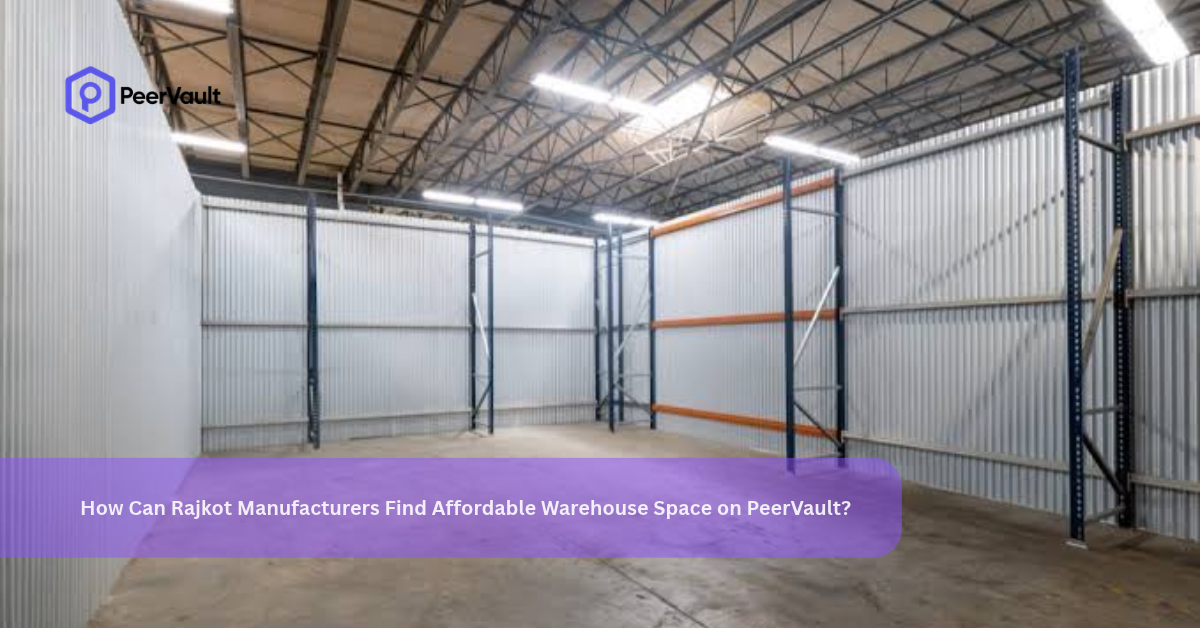
How Can Rajkot Manufacturers Find Affordable Warehouse Space on PeerVault?
TL;DR
The heavy, bulky commodities produced by Rajkot‘s dense base of small and mid-sized enterprises (foundries, engineering, auto parts) often overrun the allotted floor space. Since orders rise and fall, renting warehouse space by the month through PeerVault is often cheaper than leasing a large permanent shed.
- Define “affordable” as total monthly cost. Include transport, loading labour, insurance and security, not just rent per square foot.
- Search near your unit. Look around Aji, Bhaktinagar, Shapar-Veraval and Metoda GIDC, and keep the drive from your factory short.
- On PeerVault : filter for warehouses in Rajkot, check length, width and ceiling height, message the host, visit the space, then book on a monthly plan.
- Check before paying : floor strength, roof leaks and damp, gate and road access for your trucks, security, power, insurance cover and written terms.
- Keep costs down : store only what you need, use racking, book a size you can grow into, ask for a trial month, and review your space every few months.
- Own idle space? List it on PeerVault and earn monthly rent.
Ask a few factory owners in Rajkot what they wish they had more of, and “space” usually comes up near the top. It is rarely the production floor. It is most frequently the surrounding region, such as a location for raw materials prior to their entry into the line, finished goods awaiting transportation, or spare dies and patterns. that have nowhere to sit.
Rajkot’s industrial base has grown faster than the room around it. This article covers why warehouse space gets tight in the city, what “affordable” should mean for a small manufacturer, and how to look for space through PeerVault without paying for more than you need.
Why storage becomes a problem for Rajkot’s manufacturers
Rajkot is a dense manufacturing district. Estimates of its size vary by source and year. The Ministry of MSME’s district profile, as quoted by one industry publication, counts over 20,000 registered MSME units in the district, with engineering products taking up a large share of activity. A foundry trade-show release describes the city’s clusters as home to more than 15,000 MSME units and over 500 foundries. The numbers differ, but the picture is the same: a lot of small and mid-sized producers working in a limited area.
The product mix adds to the pressure. Diesel engines, pumps, bearings, kitchenware, watch components, automobile parts, forgings and castings form the base of the local small and medium industry. These goods are heavy, bulky or awkward to stack. A pallet of castings takes far more room than a pallet of garments, and a batch of pump housings cannot simply be piled in a corner.
Space also gets squeezed in cycles. A foundry may take a large order from an auto customer and need room for patterns, sand, castings awaiting machining and packed dispatch lots, all at once. When the order ships, that need drops. Buying or leasing a large permanent shed to cover the peak means paying for empty floor in the quiet months.
That is where flexible, rent-by-the-month space makes sense.
What “affordable” actually means for a small manufacturer
A low rent per square foot is only part of the answer. A cheap warehouse can cost more if it sits far from your unit and every movement needs a tempo or truck. Here is a fuller way to think about cost:
- Rent for the area you actually use. Taking 3,000 sq ft when 1,800 would do wastes a third of your spend.
- Commitment length. A short or monthly arrangement costs more per foot than a three-year lease, but it protects you from paying for space in months when you do not need it.
- Transport and handling. Count the cost of each trip between your factory and the storage space. Distance from the unit matters as much as the rent figure.
- Labour for loading and unloading. Some spaces have a loading dock or ground-level access. Others need you to bring your own people and equipment.
- Insurance and security. Goods that are not covered are an open risk, however low the rent.
Compare spaces on the total monthly cost of keeping goods there, not on the headline rent.
Where to look in and around Rajkot
Knowing the city’s industrial geography helps you shortlist spaces faster. A few areas come up repeatedly in discussions of Rajkot’s industry:
Bhaktinagar and Aji. Manufacturing in the district has historically been concentrated in two main industrial estates, Aji and Bhaktinagar. These are closer to the city and suit units that need quick access to customers, transporters and suppliers. Space here tends to be tighter, so options are limited.
Shapar-Veraval. Foundries and auto-component makers have clustered here for years. City planning research describes Shapar-Veraval and Metoda GIDC as strong industrial magnets, with growth pushing toward the west and south of Rajkot. If your unit is on this side, look nearby first.
Metoda GIDC. A planned estate on the outskirts that has attracted engineering and manufacturing units. Property listings for Rajkot show industrial sheds and small factory spaces in Metoda, Aji, Shapar and along the Morbi highway. That tells you where private space tends to come up.
The practical rule: pick a storage location within a short, predictable drive of your production unit and your main transport route. Saving a little on rent by going farther out often gets cancelled by the extra hauling.
How to use PeerVault to find warehouse space
PeerVault connects people who need space with hosts who have unused space. The platform lists warehouses, self storage and car parking, and covers a long list of Indian cities. Here is how a Rajkot manufacturer can use it in practice.
1. Start with the warehouse filter. On the listings page, choose the warehouse category and set your location to Rajkot. You can also filter by size, price and specific features, so you are not scrolling through spaces that are too big or too small.
2. Know your numbers before you search. Write down how many square feet you need, how tall your stacked goods are, whether you need ground-level loading, and how long you expect to need the space. Having these ready makes the search faster and your questions to hosts sharper.
3. Check the listing details carefully. Each listing shows dimensions and monthly rent. Look at the length, width and ceiling height, not just the total area. A narrow, deep space and a wide, shallow one of the same area suit very different goods.
4. Message the host before booking. The platform lets you message hosts directly. Use this to ask what the listing does not say. Is there truck access? What are the opening hours? Is power available? Can you visit first? A host who answers clearly and quickly is usually a good sign.
5. Visit the space. Photos help, but nothing replaces walking through it. Check the floor, the roof, the doors, and whether the approach road can take your vehicles.
6. Book and pay through the platform. Booking and payment run through the platform, with monthly plans, so you can match the space to your needs rather than committing to a long lease.
One honest note: availability depends on what hosts have listed in your area at a given time. If you do not see what you need in Rajkot right away, check again after a few days, widen your search to nearby areas, or look at neighbouring towns where Saurashtra’s industry also operates. Listings change.
What to check before you commit
A warehouse for manufactured goods has needs that general storage does not. Go through this list before paying.
Floor strength. Heavy castings, machined parts and dies need a floor that will not crack or sink under concentrated loads. Ask the host about the flooring, and look at it yourself.
Moisture and roof condition. Iron and steel parts rust. Check for leaks, damp walls and standing water near the entrance, especially if you will store goods through the monsoon. Even a small leak can damage a batch of finished parts.
Access for your vehicles. Measure the gate and the approach road against the largest vehicle you use. A space that cannot take your regular truck will cost you extra every month.
Security. Ask about locks, boundary walls, lighting, cameras and whether anyone is present at night. Find out who else has access to the premises.
Power and lighting. If your team will work inside the space, sorting, packing or counting, you will need basic power and light.
Insurance. PeerVault mentions insurance options for stored goods. Ask what is covered, what is excluded and how a claim would work, then decide whether the cover matches the value of what you are storing. Do not assume a general policy covers goods kept at a third-party location.
Agreement terms. Be clear about the notice period, rent increases, deposit and what happens if you want to leave early. Get the key points in writing.
Local compliance. If you store specific materials such as chemicals, oils or anything flammable, confirm that the space is suitable and permitted. When unsure, check with the host and the relevant local authority.
Ways to keep your cost down
Some habits help small manufacturers hold storage costs steady:
- Store only what has to be stored. Look at what has been sitting for months. Slow-moving stock, old patterns and obsolete spares may be better sold, scrapped or sent back than stored indefinitely.
- Use the height. If the space allows, racking can double your usable capacity without increasing rent.
- Choose a size you can grow into. Booking slightly more than you need can be cheaper than moving everything when your volume rises.
- Ask for a trial period. If the host agrees, try the space for a month before committing to a longer plan.
- Plan your transport. Move goods in full loads on scheduled days instead of making frequent small trips.
- Review every few months. If your needs shrink, reduce the space. If they grow, add rather than guess.
Common mistakes to avoid
Choosing on price alone. The lowest rent often comes with problems: poor access, weak security or a damp floor.
Skipping the visit. Photos can hide a leaking roof, a narrow gate or a bad approach road.
Not asking about access hours. Some spaces are only open during limited hours, which is a problem when a transporter arrives late.
Leaving terms unclear. Misunderstandings about notice periods and deposits are easy to prevent with a short written note.
Ignoring insurance. Goods worth lakhs deserve a clear answer on cover.
If you have unused space yourself
Rajkot’s industrial areas also have owners with spare sheds, closed units or extra floor area. PeerVault works the other way too. If you have space that is sitting idle, you can list it and earn monthly rent from a business nearby that needs it. For a small manufacturer or property owner, that can turn a cost into income.
Final thoughts
Rajkot’s manufacturers do well by being practical, and that applies to warehousing too. Space needs rise and fall with orders, so a fixed, oversized warehouse is not always the best match. Renting only what you need, close to your unit and with the right access and security, usually works out cheaper in the long run.
PeerVault gives you one place to search for warehouse space, talk to hosts and book on monthly terms. Start with your size and location, compare a few options, visit before you commit, and ask the hard questions about floors, access and insurance. A careful hour of checking now can save a lot of cost and trouble later.
If you are ready to look, open the warehouse listings on PeerVault and filter for Rajkot.
Contact Us to Find Affordable Warehouse Space in Rajkot
Popular Posts