

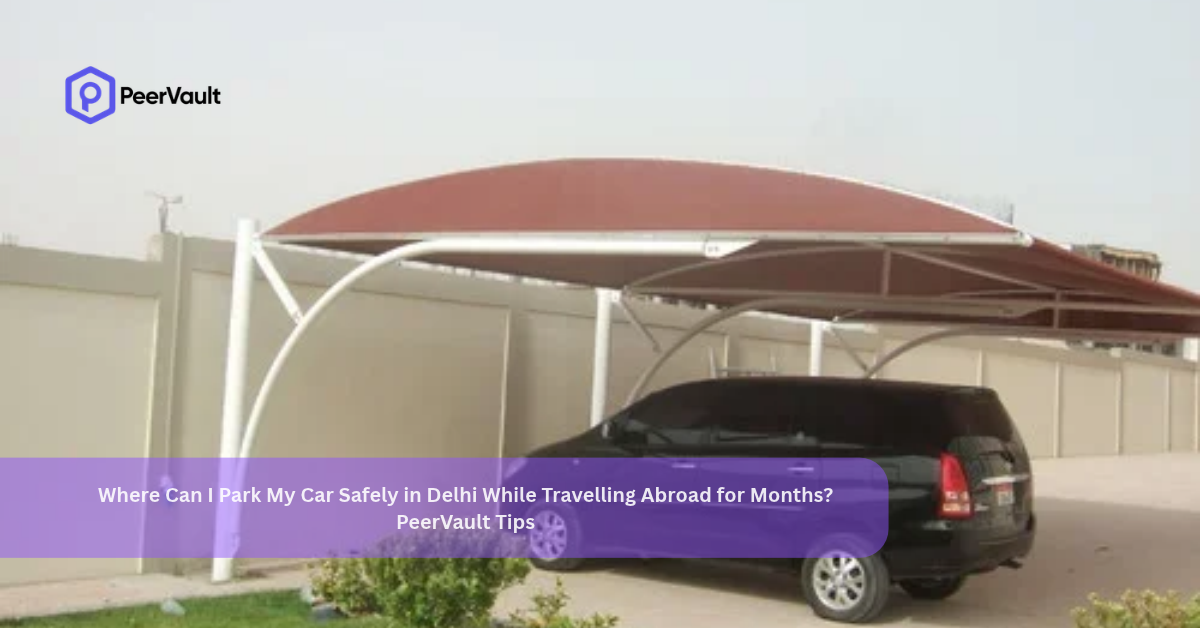
Where Can I Park My Car Safely in Delhi While Travelling Abroad for Months? PeerVault Tips
TL;DR
If you’re leaving Delhi for two months or more, don’t leave your car on the street. Keep it in a covered, locked spot where the owner is easy to reach. Good options are a relative’s society, a private space rented by the month (for example through PeerVault), an airport long-term lot, or a storage facility. For most people, a private covered space at a few thousand rupees a month is the best balance of safety and cost.
Before you fly :
- Fill the fuel tank, raise tyre pressure slightly, clean the car and use a breathable cover.
- Plan for the battery: start the car every two weeks, fit a trickle charger, or disconnect the terminal if the manual allows it.
- Check that your insurance and PUC are valid, and tell your insurer where the car will be parked.
- Leave documents and a spare key with a trusted person in Delhi, and take a dated video of the car at handover.
- If your car is a diesel over 10 years old or a petrol over 15, keep it on private premises. Delhi’s rules on these vehicles keep changing.
You have the ticket booked, the visa stamped, and a three-month posting or a long family trip ahead. Then someone asks the question nobody planned for: what happens to the car?
If you live in Delhi, this is not a small question. The city has one of the highest vehicle counts in the country, parking is tight in most colonies, and a car left on the road for weeks collects dust, dents, stray-dog scratches and sometimes a challan notice. Here’s how to handle it properly, from picking the right spot to getting the car ready and sorting your paperwork.
The short answer
For an absence of two months or more, the safest option is a covered, private, monthly-rented parking space with a verified owner, controlled entry and a fixed address you can visit or send someone to. In Delhi that usually means one of four things: a spot in a relative’s society, a private garage or covered parking space rented from a host, a long-term airport lot, or a professional storage facility. Leaving the car on the street outside your house is the one choice that goes wrong most often.
Platforms like PeerVault list private car parking spaces by city, size and monthly price, so you can compare a few before you fly.
Why the road outside your house is a poor choice
People assume that if the car sits there every night anyway, a few extra weeks make no difference. They do, for a few reasons.
Nobody is watching it. Daily use is a quiet security measure. Neighbours and guards notice when a car is moving. A car that has not moved in six weeks is easy to spot as unattended.
Public parking rules are tightening. Delhi has talked for years about charging for on-street parking in residential colonies, and the Delhi Maintenance and Management of Parking Rules were framed around that idea, with civic agencies deciding charges after consulting resident welfare associations. Enforcement varies by colony, but a car that blocks a lane or a gate for months invites complaints and towing.
Weather and dust do real damage. Delhi summers bake paint and dashboards. The monsoon brings waterlogging in low areas. Winter smog leaves a thick film on glass and paint that is harder to clean if it sits for weeks.
Older cars face an extra risk. This should be placed in a separate section below.
Your realistic options in Delhi
1. A relative’s or friend’s covered parking
This costs nothing and works well if the society has a gate guard and CCTV. The problems are practical. Housing societies often limit the number of cars per flat, and a guest car parked for months may not be welcome. Get the society’s permission in writing and share your car details with the guard.
2. Airport long-term parking
If you fly from Delhi, airport lots are convenient, and some take bookings for extended stays. The catch is cost and rules. Most are priced for days, not months, and long-term policies can change. Ask for the daily rate, the maximum stay, and whether they will move the car during the period. Do the maths before you commit, because a daily rate multiplied by 90 days gets large quickly.
3. MCD or other public parking lots
MCD runs authorised parking sites across the city. According to an MCD rate list reported in the press, a monthly day pass for a car was fixed at around ₹1,200, and a day-and-night pass at around ₹2,000. These are public lots, built for commuters, so they are not designed for months of storage with nobody checking on the car. Rates also change, so confirm locally.
4. A private space rented from a host
This is the middle option that many travellers overlook. A homeowner, builder-floor owner or shop owner with a spare covered bay rents it by the month. You get a defined spot, a person to call, and usually a price well below a commercial garage. The quality varies, which is why checking the host properly matters (more on that below).
5. A professional vehicle storage facility
These exist in the NCR and suit high-value or classic cars. They cost more, and they are not in every neighbourhood. For a regular hatchback or sedan, a good private space is usually enough.
What a safe parking spot looks like
Before paying anyone, run through this list.
- Covered or enclosed. Roof overhead, or at least a boundary wall. Direct sun and falling debris cause most of the cosmetic damage.
- Controlled access. A gate, guard or lock. Ask who else has the keys.
- Space to move around the car. Tight bays lead to door dings when other cars squeeze in.
- Dry floor. Check for seepage in the monsoon, especially in basements.
- Good lighting and CCTV. Even one working camera helps.
- Reachable owner. You should be able to message or call the host, and so should your emergency contact in Delhi.
- A written agreement. Even a simple one-page note covering dates, rent, and what happens if the car is damaged.
How to use PeerVault for this
PeerVault is a peer-to-peer platform where people with unused space list it, and people who need space rent it by the month. It has a dedicated car parking category, and the listings show the size of the bay and the monthly rent upfront. For instance, car parking spaces in places like Noida, Bengaluru, Chennai, and Pune are listed for between ₹2,000 and ₹5,500 per month. Delhi’s availability varies, so look throughout your neighborhood and the surrounding areas of Noida, Gurugram, or Ghaziabad as well, as a taxi or metro ride from there is less expensive than Delhi parking prices.
Here’s a logical approach to it:
1. Search by area, not just city. Pick locations close to your home or close to a relative who can check on the car.
2. Filter by size. Measure your car. A Swift fits a 10′ x 15′ bay easily. An SUV needs more room to open doors.
3. Message the host through the platform. Ask about covered or open, gate access, CCTV, and whether anyone else will park nearby.
4. Ask about visiting rights. You may want your brother or a friend to start the car now and then.
5. Check the verification and insurance details. PeerVault says users are verified and insurance options are available. Read what the cover actually includes and what it excludes before you book. Also confirm with your own motor insurer that the car is covered while parked at a third-party location.
6. Take a video of the car and the space on the day you hand it over. Date it, and share it with the host.
Pay through the platform rather than in cash. That keeps a record if anything is disputed.
Get the car ready for months of sitting
A car that sits unused loses a bit every week. A few steps cut the damage.
Battery. This is the most common failure. A modern car drains its battery slowly even when off, because of the alarm, clock and control units. Options: ask someone to start the car and run it for 15 to 20 minutes every two weeks, fit a trickle charger if the spot has power, or disconnect the negative terminal if your manual allows it. Check the manual first, since some cars lose settings or need re-coding.
Fuel. Fill the tank before you go. There is less space for moisture and condensation when the tank is full. For very long gaps with petrol, a fuel stabiliser is worth asking your mechanic about.
Tyres. Raise the pressure a little above normal, as your manual suggests for storage, to reduce flat spots. Better still, ask the person checking the car to roll it a metre or two each visit.
Handbrake. Leave it off if the car is on level ground. Use wheel chocks. A handbrake left on for months can seize.
Clean it inside and out. Remove food wrappers, bags and anything that attracts rats or insects. Wash and wax the paint before storage. Bird droppings and tree sap left on paint eat into the finish.
Pests. Rats chew wiring, and Delhi has plenty of them. Keep the bay free of grain and food waste, and ask about pest control in the space. Some owners place naphthalene balls or steel wool around the tyres and exhaust opening, but do not leave anything inside the engine bay unless a mechanic says it is fine.
Cover. Use a breathable, fitted cover. Plastic or cheap tarpaulin traps moisture and scratches paint when the wind moves it.
Wipers and windows. Lift the wipers off the glass or put a cloth under them, and keep the windows fully closed.
Paperwork and insurance before you leave
This part gets skipped, and it is the part that costs real money.
- Insurance validity. Check the expiry date. If it falls while you are abroad, renew before you go. Driving or claiming on a lapsed policy is a problem, and third-party cover is legally required for any vehicle in public use.
- Own-damage cover. A comprehensive policy generally covers theft, fire and natural calamities, but read the terms. Tell your insurer where the car will be parked.
- PUC certificate. It needs to be valid when the car is back on the road. Renew it on return if it expires during your trip.
- Documents. Keep original RC and insurance papers with a trusted person in India, not in the glovebox. Leave scanned copies with the host and your emergency contact.
- Emergency contact. If you cannot be reached, provide the host with the name and phone number of someone in Delhi who can step in.
- FASTag and challans. Keep the car off the road, but check for pending challans on the Parivahan portal after you return.
A note for owners of older cars
Delhi’s rules on end-of-life vehicles have changed several times, and they are still in dispute in court. According to previous directives, diesel vehicles older than ten years and gasoline vehicles older than fifteen years are considered end-of-life. The Delhi government has stated that these vehicles may be seized if they are found operating or parked in public areas. Supreme Court orders in 2025 paused coercive action for some vehicles, with BS-IV or better emission standards in focus, but the position has been revised more than once.
If your car is near or past those ages, do not leave it on a public road. Keep it inside private premises, and check the current position with the Delhi Transport Department before you fly. An impounded car while you are overseas is a hard problem to solve from another time zone.
What does it cost?
Costs depend on the area and the type of space.
- A relative’s parking: free, though a small thank-you gift is polite.
- MCD monthly pass: roughly ₹1,200 to ₹2,000 based on the rate list reported in the press, if a lot near you offers one.
- Private covered space through a platform like PeerVault: often between ₹2,000 and ₹6,000 a month, depending on location and size. South and central Delhi are at the higher end.
- Airport long-term parking: usually the most expensive per month.
- Professional storage facility: highest, but with extra services.
For a three-month trip, a private space at a few thousand rupees a month is usually the practical balance of safety and cost.
Common mistakes to avoid
1. Leaving the car at a friend’s place with no written permission. A society committee can ask for it to be moved at short notice.
2. Skipping the battery plan. Many people return to a dead car and a tow.
3. Choosing the cheapest spot without visiting it. If you cannot go yourself, send a friend and ask for a video call.
4. Not telling the insurer. If a claim comes up, an unexpected location can create friction.
5. Forgetting the spare key. Leave one with your emergency contact, not with the host unless you trust them fully.
Frequently asked questions
Is it safe to park a car for three months in Delhi? Yes, if it is covered, locked in, and checked now and then. Open roadside parking with no oversight is where most problems come from.
Can I rent a parking space in Delhi for just a few months? Most private hosts rent by the month, and some accept short stays. Ask about a minimum period before you pay.
Does my insurance company need to know? It is a good idea to inform them where the vehicle will be kept, and to check that your policy is active for the entire period.
Should I disconnect the battery? It depends on the car. Consult your service center or the handbook. If you cannot arrange regular starts, a trickle charger or terminal disconnection is the usual solution.
Is a peer-to-peer parking space reliable? It can be, if you check the host, visit or video-call the space, and keep a written record of the arrangement. Treat it like renting a flat: look first, then pay.
Final thoughts
A long trip abroad should not turn into a problem with the car. Pick a covered, locked space, prepare the car for sitting, sort out the insurance and papers, and name someone in Delhi who can check on it. If you want a private space rather than a public lot, browse the car parking listings on PeerVault and compare a few options near your home before you fly. A little planning now means your car starts, looks the same, and is waiting when you land.
Contact Us for Reliable Long-Term Parking with PeerVault
Popular Posts