

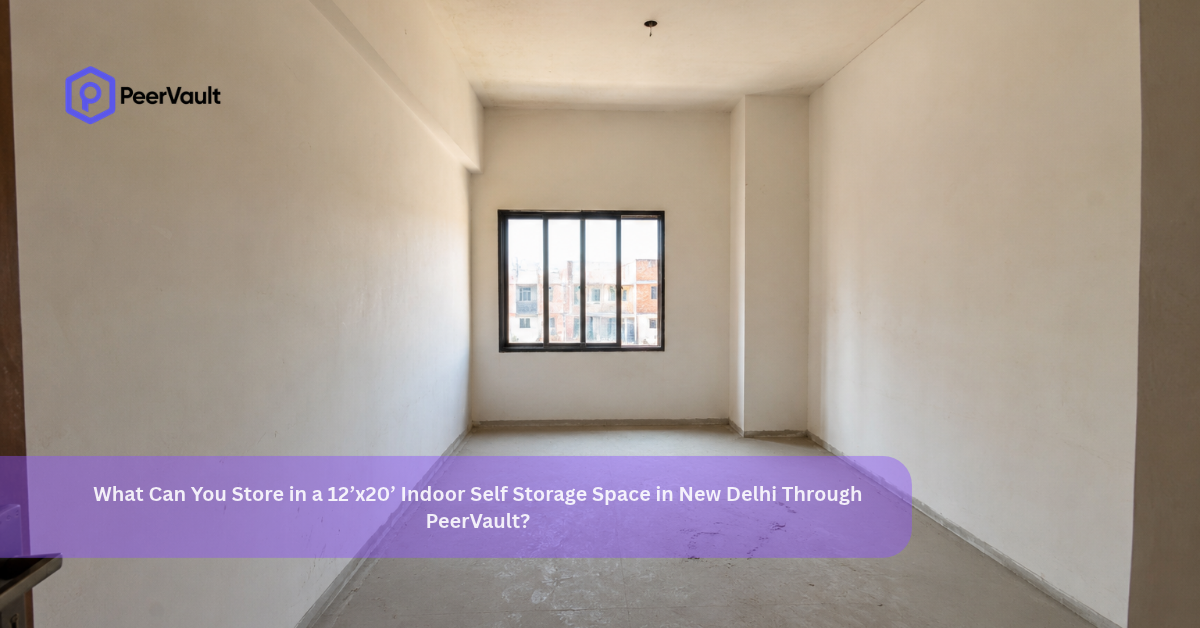
What Can You Store in a 12’x20’ Indoor Self Storage Space in New Delhi Through PeerVault?
TL;DR
A 12’x20’ indoor self storage space in New Delhi provides around 240 square feet of floor area. It can be useful for storing household furniture, moving boxes, seasonal items, office furniture, permitted business inventory, documents, and selected appliances. The amount you can store depends on the size of your belongings, ceiling height, packing method, and how efficiently the space is organized.
Finding suitable storage space can be challenging in a crowded city like New Delhi.Homes may have limited room for extra belongings, while businesses may need additional space without renting a larger office or warehouse. A 12’x20’ self storage space can provide a practical middle option when a small storage unit is not enough.
An indoor storage location can help keep belongings organized and away from the main living or working area. Through PeerVault, people looking for additional storage can explore available spaces based on their storage needs, location, budget, and other requirements.
Before selecting a storage space, it is important to check the exact dimensions and understand what can be stored there. The actual usable capacity may vary depending on the layout, ceiling height, size of the belongings, and available access space.
To make better use of 240 square feet, organize items carefully. Use labelled boxes, place larger belongings strategically, disassemble suitable furniture when possible, and keep frequently needed items near the entrance. Leaving a walkway can also make it easier to reach items stored at the back.
Before choosing a 12’x20’ indoor self storage location in New Delhi through PeerVault, check important details such as access hours, security, loading facilities, storage restrictions, pricing, availability, and indoor conditions. Choosing a space based on your actual storage needs can help you avoid paying for unnecessary space while ensuring your belongings have enough room.
What Is a 12’x20’ Self Storage Space?
A 12’x20’ storage space measures approximately 12 feet wide by 20 feet long, giving you around 240 square feet of floor space.
That is considerably more room than a small personal storage unit. It can be suitable for people who have accumulated furniture, household belongings, business inventory, equipment, documents, or other items that do not need to remain at home or in an office.
The word indoor is also important. An indoor storage location may be preferable when you want your belongings kept inside a building rather than exposed directly to outdoor conditions.
However, every storage location is different. Before moving your belongings, check the actual listing for details such as access arrangements, security, operating hours, ventilation, loading facilities, restrictions, and any other conditions.
What Can You Store in a 12’x20’ Indoor Self Storage Space in New Delhi?
A 12’x20’ indoor space can accommodate a wide range of belongings when they are packed and arranged properly.
Some common examples include :
- Household furniture
- Sofas and chairs
- Beds and mattresses
- Tables and desks
- Chairs
- Cupboards
- Boxes of household belongings
- Seasonal decorations
- Books
- Clothing
- Kitchen items
- Small business inventory
- Office furniture
- Files and documents
- Packaging materials
- Non-perishable products
- Sports equipment
- Hobby equipment
- Selected appliances
- Moving boxes
The exact capacity will depend on the dimensions of your belongings. For example, storing several large cupboards without disassembling them will use much more floor space than storing flat-packed furniture.
Is a 12’x20’ Space Suitable for Storing Household Furniture?
Yes, household furniture is one of the most practical uses for a space of this size.
A family moving to a smaller home may need temporary storage for furniture that cannot fit into the new property. Similarly, someone renovating a home may want to move furniture out of the house for several weeks or months.
A 12’x20’ space may be able to accommodate items such as :
- Sofa sets
- Dining tables
- Dining chairs
- Beds
- Mattresses
- Study tables
- Office chairs
- Cupboards
- Shelving units
- Side tables
- TV units
- Other household furniture
Large furniture should ideally be measured before moving it.
One simple mistake is assuming that because the total area is 240 square feet, every piece of furniture will automatically fit. Door width, ceiling height, corners, pillars, and the way the furniture needs to be moved into the space can affect the actual usable capacity.
Can You Store Moving Boxes in a 12’x20’ Indoor Storage Location?
Yes. Moving boxes can make very efficient use of a storage unit because they can be stacked.
For example, instead of placing loose clothes, books, toys, kitchen items, and decorations directly on the floor, you can pack them into properly labelled boxes.
Try to keep heavier boxes toward the bottom and lighter boxes on top.
It is also helpful to leave a narrow walkway so you can reach items at the back without having to remove everything in front.
Here is a simple way to arrange the items :
Back section: Items that are rarely needed
Middle section: Furniture and larger belongings
Side sections: Stacked boxes
Front section: Items you may need regularly
This approach can make a 12’x20’ space much easier to manage.
Is a 12’x20’ Storage Space Suitable for Business Inventory?
Small businesses can use it as extra space for storing inventory.
For example, an online seller may have products stored at home but eventually run out of room. Renting a separate storage space can help keep business inventory away from personal belongings.
A 12’x20’ indoor location may be suitable for storing :
- Packaged products
- Retail stock
- Boxes
- Packaging materials
- Promotional materials
- Display items
- Non-perishable inventory
- Business equipment
- Seasonal stock
Before using a storage location for business purposes, check whether the specific property permits commercial inventory. Also confirm whether there are restrictions on the type of goods that can be stored.
Storage is not the same as a warehouse designed for every type of commercial activity. The listing terms should always be checked before making arrangements.
Can You Store Office Furniture?
Yes, office furniture can be another good use of a 12’x20’ storage space.
A company relocating, renovating an office, downsizing, or temporarily changing its workspace may need somewhere to keep desks and chairs.
Depending on the dimensions and quantity, you may be able to store :
- Office desks
- Chairs
- Filing cabinets
- Small conference tables
- Shelving
- Storage cabinets
- Reception furniture
- Non-sensitive office equipment
Disassembling desks and shelving units where possible can save considerable space.
Keep screws, bolts, and other small parts in labelled bags and attach them to the relevant furniture. This makes it much easier to put everything back together when needed.
Can Students Use a 12’x20’ Self Storage Space?
Students generally do not need 240 square feet individually, but a larger unit can sometimes make sense when belongings are being stored for a group or during a longer relocation.
For example, students moving between accommodation or returning home temporarily may need somewhere to keep :
- Books
- Clothes
- Small furniture
- Study materials
- Sports equipment
- Suitcases
- Household items
For a single student with only a few boxes, a smaller storage option may be more economical. When the volume of belongings is significantly greater, a 12′ x 20′ unit becomes more practical.
Can You Store Seasonal Items?
Seasonal storage is another practical use.
Many households have belongings that are used only during particular times of the year. Keeping everything at home can take up valuable cupboard or room space.
A storage space may be used for items such as :
- Festival decorations
- Holiday decorations
- Extra bedding
- Seasonal clothing
- Suitcases
- Camping equipment
- Party supplies
- Event decorations
Label each box according to its contents. Instead of writing only “miscellaneous,” use descriptions such as “Diwali decorations,” “winter clothes,” “kitchen items,” or “wedding decorations.”
This makes finding something later much easier.
Can You Store Appliances?
Some household appliances may be suitable for indoor storage, depending on the storage provider’s rules and the condition of the appliance.
Examples may include :
- Refrigerators
- Washing machines
- Microwaves
- Small kitchen appliances
- Fans
- Non-permanent household equipment
Appliances should be cleaned and completely dry before storage.
For example, a washing machine should be drained properly before being placed into storage. Keeping moisture trapped inside an appliance for a long time can create problems.
Always check the storage provider’s rules before storing electrical or large appliances.
What Should You Not Store?
Not every item belongs in a self storage space.
Restrictions vary between locations, so the specific PeerVault listing and storage provider should be checked before moving anything.
Items commonly restricted by storage providers can include hazardous, illegal, flammable, explosive, or otherwise unsafe materials.
You should also avoid storing items that require special environmental conditions unless the facility specifically provides those conditions.
Examples may include :
- Highly flammable materials
- Explosives
- Illegal substances
- Perishable food
- Items that can leak
- Dangerous chemicals
- Certain biological materials
- Other prohibited goods
When in doubt, ask the storage provider before bringing the item to the location.
How Much Can Fit in a 12’x20’ Storage Space?
There is no single answer because the amount depends on the size of your belongings and how efficiently the space is arranged.
The floor area is approximately 240 square feet, but the usable storage capacity is also influenced by ceiling height and the ability to stack items safely.
For example, twenty medium-sized boxes arranged efficiently will use space differently from twenty large pieces of furniture.
The best way to estimate your requirements is to make an inventory before renting.
Write down :
1. Number of furniture pieces
2. Number of boxes
3. Approximate box dimensions
4. Large appliances
5. Items that cannot be disassembled
6. Items you need to access frequently
7. Items that can be stacked
This gives you a much better idea of whether a 12’x20’ space is appropriate.
How Should You Organize a 12’x20’ Indoor Storage Space?
Good organization can make a big difference.
Do not simply place everything wherever there is an empty spot. Plan the storage layout before moving everything inside.
1. Put large items at the back
Furniture and belongings that you will not need often can go toward the back.
2. Place commonly used things close to the entrance.
If you regularly need certain boxes or equipment, keep them closer to the door.
3. Label every box
Put labels that are easy to see on both sides of every package.
4. Leave a walkway
Do not occupy every square inch of the floor. A small walkway makes the unit much easier to use.
5. Use vertical space carefully
If the storage location allows stacking, use suitable shelving or stack stable boxes safely.
6. Keep an inventory
A simple phone note or spreadsheet can record what is inside each box.
For example :
Box 1 – Winter clothes
Box 2 – Books
Box 3 – Kitchen items
Box 4 – Office documents
This saves time later.
Why Choose an Indoor Storage Location in New Delhi?
New Delhi is a busy urban area where residential and commercial space can be limited. When you do not want to move to a bigger house just to have more space, extra storage can be helpful.
An indoor location can also be convenient for belongings that you want kept inside rather than in an open area.
Potential advantages include :
- Better use of home space
- Extra room for business inventory
- Easier organization
- Temporary storage during relocation
- Space during renovation
- Storage for seasonal belongings
- Separation of personal and business items
The actual benefits depend on the individual storage location and its facilities.
How Can PeerVault Help You Find Storage Space?
For those who want to locate or post available spaces, PeerVault can be helpful.
Instead of assuming that every storage requirement needs a traditional warehouse, users can look for a space that better matches the amount of room they actually need.
For someone searching for 12’x20’ self storage in New Delhi, the important part is not only the size. The location, access, storage conditions, pricing, availability, and rules should also be considered.
Before choosing a listing, compare the details carefully.
A suitable storage space should match both your physical storage requirements and your practical needs.
What Should You Check Before Renting Through PeerVault?
Before committing to a 12’x20’ indoor storage location, ask a few basic questions.
Is the space actually 12’x20’?
Confirm the dimensions rather than relying only on a general description.
Is it completely indoors?
Verify the placement of the storage room if you prefer an indoor setting.
What are the access hours?
You may need access at different times, especially if you are storing business inventory.
How secure is the location?
Ask about available security arrangements and access control.
Is there a loading area?
Large furniture can be difficult to move without a suitable loading or unloading arrangement.
Are there restrictions on what you can store?
Always confirm this before bringing your belongings.
Is there enough ventilation?
This can be important when storing furniture, clothing, documents, and other items for longer periods.
What is the payment arrangement?
Understand the rental period, payment schedule, deposit requirements, and any additional charges before confirming.
Can you access your belongings whenever you need them?
Some storage arrangements may have specific access rules.
These questions can prevent misunderstandings later.
How Can You Prepare Your Belongings Before Storage?
Preparation is just as important as choosing the right space.
Clean furniture before storing it. Make sure clothing and fabrics are completely dry. Pack smaller items in sturdy boxes and avoid overloading them.
For wooden furniture, consider suitable protective covering while still allowing appropriate ventilation according to the storage conditions.
For documents, use sealed and labelled boxes where appropriate, but make sure the storage environment is suitable for paper.
Avoid placing extremely heavy objects on top of fragile belongings.
A few hours spent preparing everything properly can make the storage period much easier.
Should You Disassemble Furniture?
Whenever practical, yes.
A large bed frame or dining table can occupy considerably more space when fully assembled.
If the furniture can be safely dismantled, doing so may allow you to use the available space more efficiently.
Keep all hardware in clearly labelled bags. Take photographs before dismantling complicated furniture so that you have a reference when putting it back together.
Do not dismantle furniture if doing so could damage it or if the manufacturer specifically advises against it.
How Can You Make the Most of 240 Square Feet?
Think of the storage space as a small room rather than simply an empty floor.
Create zones.
One section can contain furniture. Another can contain boxes. A third can hold items you need more often.
Use the height of the room where permitted, but do not create unstable stacks.
You can also group belongings by purpose.
For example :
Household zone: Furniture and home items
Business zone: Inventory and packaging
Seasonal zone: Decorations and seasonal clothing
Access zone: Items needed regularly
This approach makes a large storage space feel much more manageable.
Is a 12’x20’ Storage Space Good for Long-Term Storage?
It can be, provided the storage location is suitable for long-term use and the items are prepared properly.
Long-term storage requires more planning than storing items for a few days or weeks.
Before storing belongings for several months, consider :
- Moisture
- Ventilation
- Security
- Pest control
- Packaging
- Item sensitivity
- Access requirements
- Insurance or liability arrangements
- Provider rules
It is also a good idea to check your stored belongings periodically if the terms of the location allow it.
Is 12’x20’ Self Storage Better Than Renting a Larger Property?
Not necessarily. It depends on what you need the space for.
If you simply need somewhere to keep belongings, renting a separate storage space can make more sense than paying for a larger home or office.
If you need to work from the space, operate machinery, receive customers, or carry out regular business operations, a self storage location may not be appropriate.
The purpose of the space should guide your decision.
For storage alone, 240 square feet may provide a practical middle ground between a small storage unit and a much larger warehouse.
How Can New Delhi Residents Decide If 12’x20’ Is Enough?
Start by measuring your belongings.
Do not estimate everything based on the number of boxes alone. Measure your largest furniture pieces and identify anything that cannot be folded, dismantled, or stacked.
Then calculate how much floor space those items require.
If you are moving house, create an inventory before packing.
If you are a business owner, estimate your average inventory volume rather than only your current stock.
This is particularly important if your inventory changes throughout the year.
A 12’x20’ space may be comfortable for one type of storage need and too small or unnecessarily large for another.
What Makes PeerVault Useful for Storage Searches?
The main advantage of using a space marketplace is the ability to search for a storage arrangement based on your requirements rather than automatically choosing a traditional storage facility.
For someone looking specifically for a 12’x20’ self storage indoor location in New Delhi, the search can begin with the required size and then narrow down the choice using other practical factors.
Before selecting a listing, compare :
- Space dimensions
- Location
- Indoor or outdoor arrangement
- Access
- Security
- Price
- Storage rules
- Availability
- Loading arrangements
- Suitability for your belongings
The cheapest option is not always the most suitable. A slightly different location may be more convenient if you need frequent access.
Frequently Asked Questions
What is the size of a 12’x20’ self storage unit?
A 12’x20’ unit provides approximately 240 square feet of floor area. The actual storage capacity depends on the ceiling height, layout, access point, and the size of your belongings.
What can you store in a 12’x20’ indoor storage space?
You may be able to store furniture, household boxes, seasonal belongings, office furniture, business inventory, documents, and other permitted items. Always check the specific storage provider’s rules.
Can businesses use a 12’x20’ storage space?
A small business may use such a space for permitted inventory, packaging materials, furniture, or equipment. However, the provider should confirm that commercial storage is allowed.
Is a 12’x20’ space enough for household furniture?
It can be, depending on the amount and size of furniture. Disassembling suitable furniture and organizing boxes efficiently can increase the usable capacity.
Can I find a 12’x20’ indoor storage location through PeerVault?
PeerVault can be used to explore available space listings, but availability and specific terms can change. Check the current listing details before making a decision.
How should I organize a 12’x20’ storage space?
Keep rarely used belongings toward the back, frequently needed items near the entrance, and leave a walkway where possible. Label boxes clearly and maintain a simple inventory.
What should I check before renting self storage in New Delhi?
Check the exact dimensions, location, access hours, security arrangements, indoor conditions, storage restrictions, loading arrangements, rental terms, and any additional charges.
Final Thoughts
A 12’x20’ indoor self storage space in New Delhi offers around 240 square feet of floor area, making it a practical option for many household and small-business storage needs.
It can be used for furniture, moving boxes, seasonal belongings, office items, permitted business inventory, and other possessions that are taking up too much room at home or work.
The key is to choose the space based on your actual requirements rather than size alone. Think about access, security, location, storage conditions, permitted items, and how often you need to reach your belongings.
If you are searching for a 12’x20’ Self Storage – Indoor location in New Delhi, PeerVault can be one place to explore available space options. Before choosing a listing, review the individual details carefully and confirm that the space is suitable for the items you plan to store.
A well-organized storage space can do more than simply hold your belongings. It can free up room at home, make business inventory easier to manage, and give you a practical place to keep items you do not need every day.
Popular Posts